30/10/10

Crypto Primer: Understanding encryption, public/private key, signatures and certificates

Planky 22 Oct 2010 4:57 PM

So much of what I will write on this blog will assume a knowledge of crypto. I thought I’d create a post I could reference back to for many future posts to keep things simple and easy to understand.

Algorithms and Keys
We all know what an algorithm is. In cryptography it’s not the algorithm you keep secret. The algorithm should be designed in such a way that if it is discovered, unless the snooper has the key, it is useless to him/her. Many algorithms are publicly published. Key secrecy is what’s important. It even goes as far as to say that if you know the algorithm, in other words, you know what mathematics was used and you also know the ciphertext itself, a good encryption algorithm will still keep the plaintext data secret! It sounds impossible because if somebody told me “the answer is 27 and I know to get that number the algorithm divided by 10, added 4 then multiplied by 3”, I’d be able to pretty quickly calculate the input was 50. But these algorithms use special one-way functions (which we’ll look at in a moment) which make that impossible (or at least so difficult you’d never bother to attempt it) to do.

There are 2 broad classes of algorithm: symmetric and asymmetric.
a) Symmetric algorithms use the same key for both encryption and decryption.
b) Asymmetric algorithms, such as public/private key cryptography use one key for encryption and a different, though mathematically related key for decryption. That last sentence sounds counter-intuitive. As does the idea that publishing your algorithm still maintains secrecy. But that’s the truth. Of course an algorithm is only secure until/if somebody finds a weakness.

There is a scenario known as the doomsday scenario. This is the day somebody publishes an algorithm for predicting prime numbers. Almost the entirety of public/private key cryptography (used by protocols such as SSL/TLS) is based on the notion that there is no pattern to a series of prime numbers, other than that they are prime.

There is a possibility that somebody has already come up with a prime-prediction algorithm. It would certainly be in their interest to keep it secret!

The encryption algorithm has 2 inputs – plaintext and the key. It has one output, ciphertext.

If decrypting data, 2 inputs: ciphertext and the key. It has one output, plaintext.

One Way Functions
Mathematical functions where it is difficult (or impossible) to get back to the source values, knowing only the output values, are known as one-way functions. There are many, but modular arithmetic gives us a method that is used extensively in cryptography.

A simple example is where, on a 12 hour clock face, you add 5 hours to 9am. The answer is 2 pm. Or written down we could say:
9+5=2
Because this is an example of modular arithmetic where the modulus is 12, we’d actually write:
9+5=2(mod12)
Let’s take a simple function:
3x where x=2
This is a function for turning 2 in to 9, because it’s the same as 3 * 3, which equals 9. There is a direct relationship between the magnitude of x and the magnitude of the function result. Using modular arithmetic can give the function a great property – unpredictability.
x 1 2 3 4 5 6
3x 3 9 27 81 243 729
3x(mod7) 3 2 6 4 5 1
Your password in Windows is stored as a one way function – albeit one that is considerably more complex than what you’ve just seen.

Hashes
There are some very useful algorithms that produce fixed length strings. For example it doesn’t matter how much data you feed in to an MD4 hashing algorithm, you’ll always get a 128 bit string out of it. That means there must be rather a lot of input strings that will produce exactly the same output strings – and indeed there are; they’re called collisions; they are so rare, you might as well consider them to never happen, in just the same way you are very unlikely to ever have 2 GUIDs of the same value if the programming framework you use has true randomness and a uses big enough numbers for GUIDs. MD4 is a complicated one-way function, so predicting collisions is, to all intents and purposes, impossible. Unless you keep trying and comparing the output strings. This is, in theory the only way to find out. It’s called a brute force attack. You just use computing power to very quickly run through all possible combinations. This could take a long time. A very long time. Hashes are very useful because they allow you to perform comparisons very quickly. If you have a large message, you can create an MD4 hash of the message and send the hash to somebody over a slow network. They can then run a hash on data they hold, which they believe to be identical and compare the hash you sent them, with the one they just generated. If they are the same, it means the 2 datasets are the same.

So say if I take the string “1” and put it through hashing functions – I’ll end up with:
MD4: 8BE1EC697B14AD3A53B371436120641D
MD5: C4CA4238A0B923820DCC509A6F75849B
However, if I take the string “2”, which is numerically almost identical to the first string – I’ll get massively different results.
MD4: 2687049D90DA05D5C9D9AEBED9CDE2A8
MD5: C81E728D9D4C2F636F067F89CC14862C
All this stuff comes in very useful with digital signatures which I’ll describe a little later.

Key Distribution
The problem with encrypting/decrypting data in the way I’ve told you so far, is that you have to somehow get the decryption key safely to your partner. It could easily be intercepted in this day of us all being permanently online. It’s the age-old problem that generals have had of communicating with their officers in the field for centuries. If the messenger who has the key is captured, all your communication can be decrypted, whether or not subsequent messengers know the key. This is called the key distribution problem.

3 mathematicians came up with an answer to this problem: Diffie, Hellman and Merkle. They do an exchange of data which can be intercepted by anybody but which allows both sender and receiver to generate the same key but doesn’t allow the interceptor to generate the key. Sounds incredible? It’s very simple to explain, now that you understand modular arithmetic.
Follow the steps 1 through 4. In the last step both Alice and Bob have the same key: 9. From this point on they can use 9 as their encryption and decryption key. All I can tell you is that it works. Why it works I have no idea – I am very poorly educated! However, I’m happy to live with the fact that it just works. If it’s beyond you, you’re not alone. Maybe you are also poorly educated! I do think it’s really clever, neat and cool though.

Asymmetric Key Encryption
We use one key to encrypt, and a related key to decrypt data. You can actually swop the keys round. But the point is you don’t have one key. This gets round the key distribution problem. There’s a great way of describing the difference between symmetric and asymmetric key encryption. It involves the use of a box to put messages in and we have to assume the box, its clasps and the padlock used to lock it are impossible to penetrate.

Symmetric Key: You send a messenger out with a copy of the key. He gets it to your recipient who lives 10 miles away. On the way he stops at a pub and has his pocket picked. The key is whisked off to a locksmith who copies it and it is then secreted back in to the messenger’s pocket.

Some time later you send a messenger with the box containing your message. You are confident that your recipient is the only one who can read the message because the original messenger returned and reported nothing unusual about the key. The second messenger stops at the same pub. He is pick-pocketed. The copy key is used to unlock the box and read the message. The box with its message intact is secreted back in to the messenger’s pocket. You and your recipient have no idea that your communication has been compromised. There is no secrecy…

Asymmetric Key: Your recipient has a padlock and key. He keeps the key in a private place about his person. Let’s therefore call it a private key. He puts the padlock in to the box, but leaves it unlocked. He doesn’t mind if anybody sees the padlock. It’s publicly viewable. Even though it’s not really a key, let’s call it a public key. He sends a messenger to you with the box. The messenger stops at the pub and is pick pocketed. All the snoopers see is an open padlock. They secretly return the box. The messenger arrives at your door. You take the padlock out of the box and put your message in to it. You use the open padlock to lock the box, snapping it shut and you send the messenger on his way. He again stops at the pub and is pick-pocketed. They find only a padlocked box. No key. They have no way of getting in to the box. They secretly return the box to the messenger’s pocket. The messenger gets to your recipient, who use the key he secreted in a private place about his person (the private key) and uses it to unlock the padlock and read the message. Secrecy is maintained.

You can see the process is a bit more complicated for asymmetric key than for symmetric key, so it’s not something you’d want to do often. So what is often done is that instead of putting a message in the box and padlocking it, a symmetric key is put in the box and padlocked. That way, you solve the key distribution problem. That’s what happens with computer cryptography mostly. Public/private key cryptography is used to transport a symmetric key that is used for message exchanges. One reason for doing this is that asymmetric key crypto, or public/private key crypto, as it is known, is expensive, in terms of computing power, whereas symmetric key crypto is much more lightweight. When you see that a web site uses 256 bit encryption, they are talking about the symmetric key that is used after the public/private key crypto was used to transport the symmetric key from sender to receiver. Often the key lengths for public/private key cryptography is 2048 bits. You may have found yourself confused when setting up IIS with 256 bit SSL encryption and seeing keys of 1024 or 2048 bits. This is why – it’s the difference between what’s called the session key and the public/private keys.
Although the diagram above explains how 2 keys are used, where does all this public and private key malarkey come in to play?
Let’s take the example of an ecommerce web server that wants to provide SSL support so you can send your credit card details securely over the Internet. Look at the public and private keys in the following diagram.

The public and private keys are held on the ecommerce web server. The private key is heavily protected in the keystore. Many organisations will go as far as to have a special tamper-proof hardware device to protect their private keys. The public key doesn’t need to be protected because it’s, well, public. You could have daily printouts of it in the newspapers and have it broadcast every hour, on the hour, on the radio. The idea is that it doesn’t matter who sees it.

The website generates the public and private keys. They have to be generated as a key-pair because they are mathematically related to each other. You retrieve the public key from the website and use it as your encryption key. You’re not just going to send your credit card information across the Internet yet. You’re actually going to generate a symmetric key and that is going to become the plain-text input data to the asymmetric encryption algorithm. The cipher-text will traverse the Internet and the ecommerce site will now use its private key to decrypt the data. The resulting output plain-text will be the symmetric key you sent. Now that both you and the ecommerce site have a symmetric key that was transported secretly, you can encrypt all the data you exchange. This is what happens with a URL that starts https://.

There are still a couple of problems to solve here, but let’s put them on to the back-burner for a little while. We need to understand digital signatures and certificates for those problems. In the meantime let’s have a peek at the mathematics inside the public/private key algorithm. There is an interesting little story-ette around this algorithm. A researcher at the UK’s GCHQ called Clifford Cocks invented the algorithm in 1973. However, working for GCHQ, his work was secret, so he couldn’t tell anybody. About 3 years later, 3 mathematicians, Ron Rivest, Adi Shamir and Leonard Adelman also invented it. They went on to create the security company RSA (which stands for Rivest, Shamir and Adelman). It is said the RSA algorithm is the most widely used piece of software in the world.
First, we’ll generate the public key. We pick 2 random giant prime numbers. In this case, I’ll pick 2 small primes to keep it simple; 17 and 11. We multiply them to get 187. We then pick another prime; 7. That’s our public key – 2 numbers. Pretty simple.
Now we use the public key to generate the private key. We run it through the algorithm in the diagram above. You can see we use modular arithmetic. Obviously the numbers would be massive in real life. But here, we end up with a private key of 23. The function, 7 * d = 1(mod 160) has that look of simplicity, but it’s not like that at all. With large numbers we’d need to use the Extended Euclidean Algorithm. I have to say, my eyes glazed over and I was found staring in to the distance when I read this about it:
The extended Euclidean algorithm is particularly useful when a and b are coprime, since x is the modular multiplicative inverse of a modulo b.

Now we want to use that to encrypt a message.
To keep things simple, we’ll send a single character; “X”. ASCII for X is 88. As we are the sender, we only know the public key’s 2 values: 187 and 7, or N and e. Running 88 through the simple algorithm gives us the value 11. We send the ciphertext value 11 to the ecommerce web server.

The Web server has access to the private key, so it can decrypt the ciphertext.
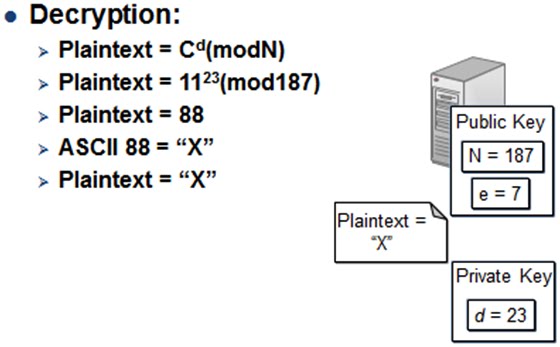
The web server passes the plaintext through the algorithm shown above and gets us the original “X” that was sent. The bit that says:
Plaintext = 11^23(mod 187)
OK – there’s actually a problem here. In this message, every “X” would come out in ciphertext as the value 11. We could perform a frequency analysis attack on the message. In the English language, certain letters tend to appear more frequently than others. The letters “e” and “i” for example are very common, but “x” and “z” are uncommon.
There is a “signature” that could be used to find the content of a message. We therefore need to encrypt much larger blocks of data than just one byte at a time.

Digital Signatures
Asymmetric keys, as mentioned earlier can be swopped around. If you use one key for encryption, you must use the other key for decryption. This feature comes in very handy for the creation of digital signatures. You’ve heard of digitally signed documents, authenticode, digitally signed applications, digital certificates and so on.
In the diagram you can see all we’ve done is combined some plaintext in to the same “message” as its equivalent ciphertext. When it’s time to check a digital signature, we reverse the process:
To check a message, we decrypt the encrypted portion, and get back plain text. We then compare that to the plain text in the message. If the 2 sets of plain text are different, it means either:
• The plaintext in the message has been altered and that accounts for the difference.
• The ciphertext in the message has been altered and that accounts for the difference.
• They have both been altered and that accounts for the difference.
In order to have a consistent message, the attacker would need to have access to the key that was used to generate the ciphertext.

Do you remember earlier, I talked about hashes? Well, because a message might be quite large, it’s often best to generate a hash of the message and encrypt that. If it’s an MD5 hash, it means you’ll only have to encrypt 128 bytes. When you come to perform the validation of the signature, you have to take the plain text portion and generate a hash before you do the comparison. It just uses the CPU more efficiently.
In this case, the message consists of a small section of ciphertext because the string-size of the input plaintext was reduced through hashing before it was encrypted. It also includes the plaintext of the message.

Depending on the data you are looking at, you’ll often even find the keys you can use to decrypt the message in plaintext within the message body. It seems like complete madness because anybody who intercepts the message could simply modify the plaintext portion of the message and then use the included key to generate a new ciphertext equivalent. That would make the message consistent.

However, if the plaintext key included in the message is the message-issuer’s public key, then the attacker would need access to the corresponding private key, which they won’t get because it’s, well, private.

But even with this there is still a problem. How do you know the message came from the sender it purports to come from? As an attacker, I could easily generate my own key-pair. I could then create a message that says I am the issuer and use my private key to create the encrypted part of the message.

When you come to check the message you’ll know that it definitely wasn’t tampered with in transit, but how do you know you can trust the public key embedded in to the message? How do you know that it’s me that created the message. That’s where digital certificates come in to play.

Certificates
Certificates are data structures that conform to a specification: X.509. But really they are just documents that do what we just talked about. The plain text data is the public key, plus other distinguishing information like the issuer, the subject name, common name and so on. It is then hashed and the hash is encrypted using the private key of a special service called a certification authority (CA) – a service that issues certificates.

When we protect a web server with an SSL certificate, we go through a 2 stage process. generating a certificate request, and then finishing it off by receiving and installing the certificate. The request part, generates a public and private key. The public key plus the distinguishing information is sent to the CA, which then creates a digitally signed document, signed using the CA’s private key. The document conforms to X.509 certificate standards. The certificate is returned by the CA, and we install it on our web server.

Anytime anybody connects to the web server over SSL, they retrieve the certificate and perform a signature validation on it. Remember it was signed by the CA’s private key. So they have to have the CA’s public key to perform the validation. If you go in to Internet Explorer’s Internet Options and then to the Content tab, you’ll se a Certificates button. That shows you all the CAs you have certificates (and therefore public keys) for. It means if you see a certificate that was signed by a CA on a web site, in theory, the CA did a check to make sure the requester was indeed the requester before issuing the certificate. It means that you have to trust that the CA did a good job of checking the requester’s validity before issuing the certificate.

Even this creates a minor problemette – how do you know the CA’s certificate wasn’t created by an imposter of some description? Well, it can have its certificate signed by a CA higher up the food-chain than itself. Eventually you get to a CA at the top of the food chain and this is called a Root CA. Internet Explorer and all the other browsers have all the main Root CAs for the Internet built-in. These are trusted organisations. They have to be! They are so trusted, they are able to sign their own certificates.

Technorati Tags: crypto primer,crypto,cryptography primer,cryptography,encryption,decryption,asymmetric key,symmetric key,public/private key,public key infrastructure,pki,certificates,digital signatures,signatures,signing,digital certificates,x.509 certificates,planky,plankytronixx
You may from time to time play with a Visual Studio command line tool called makecert.exe. It’s a tool that creates self-signed certificates. If you are just using them for development purposes on a local machine they are probably fine. You trust yourself, presumably. Sometimes you can use self-signed certificates on Internet-facing services. For example if you upload your own self-signed certificate to a service and you are sure nobody intercepted it while you were uploading it (because you were using SSL maybe), it means you can have private conversations with the service and you can be sure the service is the service you issued the certificate to. If you just sent the naked certificate, they’d be able to encrypt messages that only you could decrypt, because you’d have the private key. It’s possible to also include the private key when you create a certificate. If you send one of these certificates to an Internet service, they can digitally sign messages they send to you with your private key. Because you are assured that you gave the private key only to the service, you can be sure the messages are genuinely coming from that service and not an imposter. You have to trust that the service do a good job of keeping your private key safe.

Of course it wouldn’t be practical if every time you wanted to buy something on the Internet, in order to create an SSL connection you had to first upload a self-signed certificate. That’s why there is a large infrastructure of CAs and Root CAs built on the Internet. This infrastrucutre is called a Public Key Infrastructure or PKI. Many organisations have their own internal PKIs.
Above: Internet Explorer’s list of Trusted Root CAs.

You can also see the chain of CAs up to that chain’s corresponding Root CA when you look at a certificate.
This shows an expired certificate that was issued to my BPOS (Office 365) account by the CA called “Microsoft Online Svcs BPOS EMEA CA1”. Its certificate was in turn issued by “Microsoft Services PCA” which had its certificate issued by “Microsoft Root Certificate Authority”. As it’s a Root CA, it appears in the Trusted Root CAs container in Internet Explorer. As you walk up the chain you have to eventually get to a point where you trust the certificate. If you don’t, you’ll get a certificate error warning and a lot of messages advising you not to continue.

I’ll write another post soon that goes through a complete SSL handshake. That's a great way to explain what’s happening in crypto.

Planky Sphere: Related Content

A Hacker's Story: Let me tell you just how easily I can steal your personal data

Posted by Kole McRae on Wed, October 27, 2010 11:31 AM · Filed under Denver-Boulder, Portland, Seattle, Calgary, Edmonton, Montréal, Ottawa, Toronto, Vancouver, Victoria, Kitchener-Waterloo, Atlantic-Canada , Guest Posts and 12 other categories· 20 Comments

A little bird told me people are pissed at Google. According to some sources the streetview cars roaming the country have been recording private data from people's routers. By private they mean usernames, passwords, websites visited and more.

Because of this story I decided to show all of you just how easy it is for me to get all that same information. Tonight, I grabbed my laptop and went on a mission.

Wearing pyjama pants and an ironic t-shirt, I headed towards a large apartment building near where I live. I choose it because a lot of students live there and I could easily blend in. That and I knew there would be lots of targets.

I used to be a door to door salesman, so I know a few unique ways to get into a building, but I didn't need them. As I walked up to the door, someone else was leaving. They held the door open for me and I was in. As soon as I entered, I noticed a video camera. What I planned to do would look weird on camera and I didn't want security on my butt, so I was more careful from there onwards.

I went to the elevators and clicked the button. After a few minutes of waiting, I got on. Two other people joined me and I stood uncomfortably. I had to wait for them to click their floors so I didn't get off on the same floor as them.

When I finally made it to my floor a camera greeted me. I ducked my head low and walked over to the staircase. If security was watching me, I didn't want them knowing where I was.

After dropping down a few floors and switching to the other staircase I decided to do my dirty work on the 18th floor. The building was huge and it would take hours for them to search the entire thing. I opened up my laptop and lo and behold, there were eight insecure networks. I picked one at random and hit the mother-load.
If you look at the screenshot you can see 5 IP address. That means 5 people were connected to the network. It could be a bunch of roommates but because of what I found later I decided it was probably a few people stealing the same internet.

The program you see those IP's in is called Ettercap. It's no longer in development and I don't want to go over everything it does, lets just say it makes it so I can steal usernames and passwords among other things. All I had to do was install the program and run it.
I then opened a program called WireShark (you can see it in the second screenshot). Using this program I can easily see the websites these four people were browsing. As you can see this person is browsing IMDb. And in the next screenshot the person is... err...
I'd been watching these people browse the web for a while when I decided to go a little deeper. I did a search for MSN. It's interesting what I found.
That's mostly msn telling Microsoft's server that it's still alive but a little later on I was able to read the guys entire msn conversation. I also got his e-mail and the address of the guy he was talking too. It made for an interesting read.

I'm was just doing a little creepy stalking in the name of journalism but it would be incredibly easy for someone to use this info as blackmail or to hack into people's accounts. The information was being publicly broadcasted and was easy enough to get access too. The person who set up the router didn't bother to use a password and other people decided to steal it.

Not only this, a lot of the seemingly 'secure' networks in the building were protected with WEP encoding. Which, with a few simple tools found online, is hackable within seconds. In fact, our friends at Lifehacker.com just posted a tutorial on how to do it.

I did it one way but there are thousands of other ways to get this information. Any public network (such as at Starbucks or at your university) has this information floating around for anyone to read it. Remember that next time your chatting on MSN while at school, someone nearby could be reading the conversation.

Your best defense against people like me is to password protect your router using WPA encoding. If you don't know how to do this contact your internet service provider. They will give you step by step instructions.

Also, don't browse hardcore porn on a public network. Sphere: Related Content

11/10/10

The M in MVC: Why Models are Misunderstood and Unappreciated

I've been writing a book about the Zend Framework recently - I'm sure some of you have noticed . A while back I finished a draft of two chapters called "The Architecture of Zend Framework Applications" and "Understanding The Zend Framework". The first chapter is an exploration of the Model-View-Controller (MVC) architectural pattern and why it has become the defacto standard for adoption in web applications. The second explores how the MVC architecture relates to the Zend Framework's components, their design and interactions.

By the time I'd finished both chapters I realised I had spent a lot of space explaining the Model, most of it discussing how the Zend Framework does not actually give you one. In fact, no web application framework offers a complete Model (for reasons I'll explain later). However nearly all frameworks manage to avoid making that perfectly obvious. Instead they continually link the concept of a Model to the related, but not identical, concept of data access. This is quite misleading.

This side of frameworks never gets a lot of attention. Yet it is a massive contributor to a whole class of problems in applications which attempt to utilise MVC by adopting web application frameworks. Further, I've always found myself better entertained by banging my head against brick walls than by trying to get the idea of a Model across to other developers. I'm not saying all developers are stupid or dumb, or that they don't get the concept in general, but all developers (PHP or not) don't quite link Models to the area of practice which justifies them - Object Oriented Programming principles.

In this entry I explore Models in terms of how developers relate them to Controllers and Views in applications and note a few strategies you can employ when using proper Models.

Models Misunderstood
The Model can be explained a few ways. In fact, you can write entire books about just the Model and many people have! The Model generally has two roles broadly defined:

1. The Model is responsible for maintaining state between HTTP requests.

Basically any data whether on a database, in a file, stored in the Session, or cached inside APC must be preserved between requests and thus forms part of the state of the application at the time the last request was completed. So always remember that the Model is not just the database. Even the data you get from web services can be expressed as a Model! Yes, even Atom feeds! Frameworks which rattle off introductions to the Model, almost never explain this upfront which only exacerbates misunderstandings.

Here's an example, while it's called Zend_Feed_Reader that new component which I'm developing is actually a Model. It reads feeds, manipulates them, interprets data, adds restrictions and rules, and generally creates a usable representation of the underlying data. Without it, you have Zend_Feed (the current top dog in feed reading) which requires lots of additional work to develop it into a viable Model. In other words, where Zend_Feed_Reader is a partial Model, Zend_Feed is pure data access.

2. The Model incorporates all the rules, restraints and behaviour governing and utilising this information.

For example, if you wrote business logic for an Order Model in an inventory management application, company internal controls could dictate that purchase orders be subject to a single cash purchase limit of €500. Purchases over €500 would need to be considered illegal actions by your Order Model (unless perhaps authorised by someone with elevated authority). The Model should be capable of enforcing this.

This makes incredible sense if you examine the meaning of the word "model". We have climate models in climatology, for example, which define the data, run processes, assume behaviours and calculate probable outcomes from these. The M in MVC is called a Model for a reason. The Model doesn't just represent mere data, it represents the entire system for which that data is useful. Of course any system can be complex enough to require multiple interacting Models but you get the idea.

If you read these two points, you may realise something startling. With the exception of the UI, most of any application can be expressed within Models. It's the Model that centers on all the data and underlying behaviour of that data, and sometimes even how to display that data. It's the Model which can understand, interpret and represent that data and provide it with meaningful uses.

In Programming, Fat Models Are Preferable To Size Zero Models
Jamis Buck (the author of Capistrano now employed by 37signals) once wrote about a concept called "Skinny Controller, Fat Model" (our own Chris Hartjes wrote a blog entry on the same topic). I've always liked the simplicity of this concept since it illustrates a key facet of MVC. In this concept, it is considered best practice to maintain application logic (like our business logic from above) within the Model as much as possible and not in either of the View or Controller.

The View should only be concerned with generating and presenting a UI so users can communicate intent to the Model. Controllers are the orchestrators who translate UI inputs into actions on the Model and pass back output from whatever View has been made aware of the Model(s) its presenting. Controllers must define application behaviour only in the sense that they map user input onto calls in Models, but beyond that role it should be clear all other application logic is contained within the Model. Controllers are lowly creatures with minimal code who just set the stage and let things work in an organised fashion.

PHP developers, by and large, don't fully understand what a Model is. Many see the Model as a fancy term for database access and others equate it with various design patterns for database access like Active Record, Data Mapper and Table Data Gateway. This is the misconception frameworks often promote, unintentionally I'm sure, with abandon. By not fully comprehending what a Model is, why it's such a great idea, and how one should be developed and deployed, developers unintentionally kick themselves into a dark path which leads into what can only be described as poor practice.

Here's a thought exercise to get you thinking. Imagine you just built the finest web application imaginable using the Zend Framework. Your client is incredibly impressed and their praise (and fees) are most welcome. Unfortunately they forgot to mention that their new CTO is insisting all new applications utilise Symfony and they'll offer you a nice shiny cheque if you'll convert your application over for them. The question is - how easy will that be? Think about it for a moment...

If you have your application logic bound up in the Model - then celebrate. Symfony, like many (but not all) frameworks, accepts Models regardless of what they are written on top of. You can port your Model, its unit tests, and its supporting classes with little to no modification into Symfony. If you stuck it all into Controllers, start feeling worried. Do you think Symfony can use Zend Framework controllers? Do you think those functional tests using the Zend Framework PHPUnit plugin will magically keep work? Ta-da. That's why Controllers are not a substitute for Models. They have minimal reuse.

Unappreciated, Underestimated, Unloved: Depressed Models
Since developers often demote Models to mere database access as supplied by default in 99.9% of frameworks, it's no surprise they are unimpressed by the theoretical ideals attached to them. By focusing and obsessing about data access, developers completely miss one important factor: Models are classes which are not coupled to the underlying framework. They have no expensive setup - you simply instantiate and use them.

Maybe we can't blame the average developer though. Web applications do have a certain behavioural pattern which makes that crooked path more attractive - lots of them are just big data readers. If there is little data manipulation, only data reading, then any Model will look similar to plain old reliable data access. It's unfortunate in a way, but don't let the simplicity of reading data fool you. Not all applications are going to be read only - some will no doubt have something to do with that data besides displaying it raw and unchanged from the database

Models are the underdog in PHP. Views have captured everyone's imagination since the advent of Smarty and it's brethren. Controllers make almost as much sense since they read from databases, and pass any retrieved data into templates (a common interpretation of VC). Yep - Controllers are the logical evolution of the mentally ingrained Page Controller approach every PHP developer and their dog has used since PHP3. At least - that's the obvious conclusion for most. We'll bust the "Controller = Page Controller" myth later.

Models though. Models don't have the same ideological attraction or similarity to old habits which is why people pass them over and use "data access" as the underlying meaning. You know, like references in PHP pointing to the same value in memory? The language has changed but the same old ideas are still in play behind the scenes, strumming their discord in our neural nets.

But wait...developers do write functioning applications! So if they are not using Models brimming with application logic, what the hell are they using?!

Fat Stupid Ugly Controllers: SUC It Up
Since Models are so lame to developers, they invented a new concept. Fat Stupid Ugly Controllers (FSUC). I put the SUC in FSUC on purpose. It seemed funny at 10pm after a few drinks . And less offensive than FUC. These were invented since Models were strange, alien, and possible terrorist entities nobody really trusted with anything other than data access methods.

The average FSUC reads data from databases (using a data abstraction layer developers like to pretend is a Model), or manipulates, validates and writes it, and passes other data to the View for rendering. It's incredibly popular. I'd say most people using frameworks create them as naturally as they ever did Page Controllers. They are popular because developers have figured out that they can treat Controllers almost like Page Controllers which requires little change from their historical practice using single PHP files for every application "page".

Notice something odd? The FSUC is performing all sorts of actions on data. Why? Because without a Model, all the application logic must go into the Controller, which makes the Controller - a type of Mutated Model! I use "Mutated" with reason. FSUCs are big, unwieldy, ugly looking and definitely fat. The quasi programming term that applies is "bloated". They perform roles they were never intended for. They are a complete reversal of everything you are taught to do in applying Object Oriented Programming principles. They are also pointless! Developers, for some mysterious reason, seem to prefer FSUCs to Models despite the fact those Controllers really are just Mutated Models.

Remember our thought exercise? If you put everything into Controllers, you will never be able to efficiently migrate an application to another framework. This type of tight coupling is the kind of thing Kent Beck fans are supposed to identify as a "code smell" in Refactoring. But it's not the only smelly artifact of FSUCs. FSUCs are big, with massive methods, multiple roles (one per method usually), massively duplicated code, lacking refactored external extracted classes and...they are a nightmare to test. With many frameworks, you can't even properly apply Test-Driven Design (TDD) on Controllers without writing custom plugins and being forced to manage request objects, sessions, cookies, and Front Controller resets. Even then you have to test the View it creates because Controllers don't have output independent of Views!

So keep asking those questions! How do you test a Controller? How do you refactor a Controller? How do you limit the role of a Controller? What is the performance of a Controller? Can I instantiate a Controller outside the application? Can I chain multiple Controllers in a single process and still remain sane? Why am I not just using simpler independent classes and calling them Models? Am I considering these questions at all?

Models Are Inevitable (Like Taxes And Death)
FSUCs make the classic mistake. By assuming a Model is a silly idea and plain old data access works best, developers unwittingly stick application logic into Controllers. Yes - congratulations. You just created a Model, a butt ugly Mutated Model you insist is a Controller. But this pretend Controller isn't easily portable, testable, maintainable, or refactorable (assuming refactorable is a real word...might be!). The nature of Controllers is such that they are tightly coupled to the underlying framework. You can only make a Controller execute by initialising the entire framework's MVC stack (potentially dozens of other class dependencies!).

Either way you try to go - you end up writing the application's logic somewhere. Putting it in a Model, away from the Controller, simply creates lots of classes which are independent of the framework you're using. Now you can test those buggers all day using PHPUnit without ever seeing a Controller or View in sight or having to torture yourself silly trying to make the entire framework stack reset after every test, and by seeing them as real classes with specific roles you can also put yourself in the right mindset to apply proper refactoring and create real maintainable code without duplicating code across multiple classes.

Models are inevitable. One can call that FSUC a Controller, but it's really a Controller+Model - an incredibly inefficient Model replacement. Someone just shuffled the source code around while laughing at all the fools talking nonsense about the importance of good independent domain models. Well, laugh back. They're the ones who have to test and maintain their mess.

This is really where most web application frameworks let their users down. They are surrounded by a lot of marketing garbage which subtly suggests that they offer a full Model. Have you ever seen a framework say anything different in an obvious way? Afterall, they are MVC frameworks. If they are forced to admit the M is something developers will have to create themselves, it might look bad. So they bury the truth in the documentation scattered throughout their data access feature, if they mention it at all.

In reality, they only offer data access classes - the real Model is something that's application specific and must be developed independently by the developer after discussion with clients (you can pick your buzzword practice to achieve that - I'm into eXtreme Programming (XP) personally). It needs to be tested, validated, updated and you face the same probability of failure/success regardless of what framework you use. A bad application in Rails will still make a bad application on Code Igniter.

Controllers Should Not Guard Data
The other facet of this lack of Model consideration is that when developers are convinced that Models should be used minimally, it reinforces a reliance on Controllers to take on a new role as Data Gatekeepers (a large reason why they mutate into FSUCs). Want some more opinionated fuel to fire up everyone disagreeing with me right now?

A while back when I was writing the proposal (Zend_View Enhanced) that would eventually be adopted into the Zend Framework to create an object oriented approach to generating complex Views, I started moaning about Controllers being used as the sole method of getting data from Models into Views. My own thoughts were that Views could skip the middleman and instead use View Helpers to read data from Models more directly. This would support an architecture where in many read-only page requests, your Controller Action would be...empty. Devoid of all code. Nada.

In my mind, the best Controller is a Controller which doesn't need to exist .

I was immediately treated to a mass of resistance. Few people seemed to understand that an empty Controller, with all Model interaction extracted into simple reusable View Helpers, would reduce code duplication in Controllers (lots of code duplication!) and avoid the necessity of chaining Controller Actions. Instead there was lots of muted puzzled expressions. Most people simply assumed that MVC worked as follows: requests go to Controllers, Controllers get data from Model, Controller gives Model data to View, Controller renders View. In other words: Controller, Controller, Controller, Controller. At one point I remarked that the entire community was obsessed with Controllers . It's still tough going just to get anyone to give Views data objects, let alone let them read directly from Models...

Note: Not to sound like a complete pratt - some people did get the idea .

None of the objections really caught on that this was an old idea. Java coined the term View Helper years ago as a design pattern in J2EE showing how View Helpers could assist Views in accessing Models (only on a read only basis since any writing should go through a Controller!) without the intermediary Controller. In MVC, there is every indication that Views should know about the Models they are presenting. Not just whatever arrays we decide to spoon feed them from Controllers.

So go further! How many Views only need one Model? A lot of my Views use several Models, with highly repetitive Model calls. A View Helper is a single class - but adding these repetitive calls to Controllers, means you need to duplicate calls into multiple methods!

One crazy solution created to outwit the View Helper, is often to reimagine Controller Actions as reusable commands. Whenever a View needs several Models, you just call several Controllers in sequence. This concept is something I call Controller Chaining - its premise is to create supporting code to make reusing Controllers possible. You can translate that as: reusing every class needed to execute a single Controller Action. Remember - you can't use any Controller without initialising the entire framework . Though there are (there always are!) some exceptions.

Models are Classes, Controllers are Processes
I'm running thin on quickie ideas, but I mentioned Controller Chaining and it bears further examination. Chaining is used either to access multiple Models, or to merge the results of multiple Views, or both. Usually both - Controllers nearly always access Models and pass data into Views when you are not using View Helpers to shortcut the process.

Imagine you create three Controllers, each of which generates a View. To build some new web page, you need to merge all three Views into a single template page (or Layout). This is accomplished by telling Zend_Layout (or some other alternative solution for aggregating Views into common layouts/segments) to call all three Controllers sequentially. Now consider what is happening - three Controllers means you are making three dispatches into the MVC stack. Depending on the application this can pose a significant performance cost. Symfony, to illustrate how real that cost can be, uses "Components" as a specialised Controller type just to offset this performance hit but the Zend Framework has no equivalent. Rails has a similar idea which is rife with complaints about performance hits. The prevailing wisdom across frameworks is that using multiple full Controllers is horribly inefficient and a last resort when no other reuse strategy is available.

I'll say it again - Controller Chaining is a code smell. It's inefficient, clunky, and usually unnecessary.

The alternative is obviously to just use View Partials (template snippets capable of being merged into a single parent View) which can directly interact with Models using View Helpers. Skip the Controllers entirely - afterall they have no application logic unless translating user input into relevant Model calls (unless FSUCs ).

This highlights that Models are just a collection of loosely coupled classes. You can instantiate and call them from anywhere - other Models, Controllers and even Views! A Controller, on the other hand, is a tightly integrated cog in the machinery of a whole process. You can't reuse a Controller without also dragging in the entire process of setting up request objects, dispatching, applying action helpers, initiating the View, and handling returning response objects. It's expensive and clumsy in comparison.

Signing Off
There is a fast paced urgency to this article you'll have noticed. I'm a self confessed nut about applying the principles of elegant Object Oriented Programming to MVC frameworks. It's why I went all out with Zend_View Enhanced and saw it adopted, debated, and adapted with great success, into the Zend Framework. A lot of that is owing to Matthew Weier O'Phinney and Ralph Schindler who joined that parade. If we lose sight of simple OOP practice and principles, and get lost in trying to fight MVC into submission, the plot ss quickly lost. The MVC is a great architectural pattern - but at the end of the day our MVC interpretations and ingrained beliefs are all subservient to OOP principles. If we forget that, we do Bad Things™.

Hopefully this torrent of ideas about the Model in Model-View-Controller is somewhat enlightening and makes you think. Thinking should be your goal - question everything, and rebel when you feel something going wrong. If we run around on blind faith than we deserve everything coming to us .

Referencias
Food for thought: utilizing models in MVC
“What is a model” and “Is Zend_Db_Table a model” seem to be asked once in a while on #zftalk. Frameworks say they have a full model available, thus they are MVC frameworks. ORM libraries say they generate models. It seems the A...
Weblog: CodeUtopia
Tracked: Dec 06, 12:15

Das M im MVC-Entwurfsmuster
Ich habe vor einiger Zeit einmal über die nicht vorhandene Komponente Zend_Model geschrieben und dort den Stand der Dinge aus meiner Sicht zusammen gefasst. Das Kapitel zum Thema Models in meinem Zend Framework Buch ist bereits fast 20 Seiten lang und...
Weblog: Ralfs Zend Framework und PHP Blog
Tracked: Dec 09, 21:14 Sphere: Related Content

How to Design Programs

An Introduction to Programming and Computing by Matthias Felleisen, Robert Bruce Findler, Matthew Flatt, Shiram Krishnamurthi
(September 2003 Version, The MIT Press)

This is the first update since the third printing by the MIT Press. This release corrects mistakes and typographical errors in the first three printings.

The Book the complete text
Solutions solutions to all exercises, for teachers only !??!
Problem Sets additional problem sets not found in the book
Companion hints on how to use DrScheme
Teachpacks if you encounter bugs in your Teachpacks
Known Mistakes known typos and mistakes
DrScheme programming environment
TeachScheme! our educational outreach effort
Mail how to reach us Sphere: Related Content

The Schematics Scheme Cookbook

The Schematics Scheme Cookbook is a collaborative effort to produce documentation and recipes for using Scheme for common tasks. See the Book Introduction for more information on the Cookbook's goals, and the important ContributorAgreement statement.

Cookbook Starting Points
Table of Contents (with recipes)
Getting started with PltScheme
• The FAQ answers common questions about the Cookbook
• Common Scheme idioms
• Getting started with macros
• Using strings
• Using files

Editing Pages
•Register as an author
•Information on TWiki the software running this site.
•AuthorChapter -- A guide to contributions

Other Popular Pages:
The following pages are autogenerated:
•RecipeIndex - Recipes by chapter (similar to TOC).
•ParentTopics - List of Chapters & Sections
•AllRecipes - List of all recipes
•LibraryIndex - List of external software libraries

Administrative Pages
•AdminTopics - Summary of all administrative topics
•CookbookBrainStorm - ideas for the structure of the cookbook.
•ToDo - items to be done (a very incomplete list)
•RecipeStubs - Recipes that need to be written or completed
•HelpNeeded - Pages with markup problems
•OriginalCookbook - links to a converted version of the original cookbook
•RecentSiteChanges (last changed 09 Apr 2007 - 00:15)
•SectionIndex - This page has errors but somebody may want to fix it.

Notes:
•You are currently in the Cookbook web. The color code for this web is this background, so you know where you are.
•If you are not familiar with the TWiki collaboration platform, please visit WelcomeGuest first.

Schematics Cookbook Web Site Tools
• (More options in WebSearch)
• WebChanges: Display recent changes to the Cookbook web
• WebIndex: List all Cookbook topics in alphabetical order. See also the faster WebTopicList
• WebNotify: Subscribe to an e-mail alert sent when something changes in the Cookbook web
• WebStatistics: View access statistics of the Cookbook web
• WebPreferences: Preferences of the Cookbook web (TWikiPreferences has site-wide preferences)

The PLT Scheme is now Racket, a new programming language. The above page is for compatiblity and historical reference only. See the Racket site for up-to-date information. Sphere: Related Content

The Four Elements of Simple Design

I realize that I've never really written this down before, and I say it so frequently in my work as a trainer and mentor, that I think it bears repeating.

I have reduced everything I've ever learned about effective object-oriented design to the four elements of simple design that I first learned from Kent Beck's work. Maybe you can, too.
I define simple design this way. A design is simple to the extent that it:
* Passes its tests
* Minimizes duplication
* Maximizes clarity
* Has fewer elements
Note that I put these properties in priority order. I'm willing to copy-and-paste to get a test passing, but once the test passes, I can usually remove the duplication quickly. I'm willing to extract code into a method and call it foo() in order to get rid of duplicate code, although that name foo() rarely survives more than 15 minutes. Finally, I will gladly introduce interfaces, classes, methods and variables to clarify the intent of a piece of code, although generally speaking once I make things more clear, I can find things to cut.

Some people put “minimize duplication” and “maximize clarity” in a tie for second place. I don’t. My experience has led me to conclude that removing duplication helps more than fixing bad names does. Moreover, removing duplication tends to allow a suitable structure to emerge, whereas bad names highlight an inappropriate distribution of responsibilities. I use this observation as a key element of my demonstration, “Architecture Without Trying”.
Now I should point out that, as a test-driven development (and now also a behavior-driven development) practitioner, I write tests as I draw breath, so I don't really need to emphasize that part.
* Passes its tests
* Minimizes duplication
* Maximizes clarity
* Has fewer elements
I should also point out that I’ve yet to see a codebase with low duplication and high clarity that, nonetheless, had considerably more design elements than it needed, so I don't really need to emphasize that part, either.
* Passes its tests
* Minimizes duplication
* Maximizes clarity
* Has fewer elements
That leaves me with two key elements of simple design: remove duplication and fix bad names. When I remove duplication, I tend to see an appropriate structure emerge, and when I fix bad names, I tend to see responsibilities slide into appropriate parts of the design.
I claim these to be axioms of modular design, with a “parallel postulate” of whether you use objects or not. If you use objects, you get object-oriented design, and if you don’t, you get structured design. (I don’t know how functional design fits into this yet, because I haven’t done enough of it.)
I claim that developing strong skills of detecting duplication, removing duplication, identifying naming problems, and fixing naming problems equates to learning everything ever written about object-oriented design.
Put more simply, if you master removing duplication and fixing bad names, then I claim you master object-oriented design.
Now I wouldn't bother burning your old OOD/OOP books, but I will tell you that if you have an interested buyer, then feel free to sell them. Sphere: Related Content

30 Programming eBooks

Since this post got quite popular I decided to incorporate some of the excellent suggestions posted in the comments, so this list now has more than 30 books in it. [UPDATED: 2010-10-10]

Learning a new programming language always is fun and there are many great books legally available for free online. Here’s a selection of 30 of them:

Lisp/Scheme:
How to Desing Programs
Let Over Lambda
On Lisp
Practical Common Lisp
Programming in Emacs Lisp
Programming Languages. Application and Interpretation (suggested by Alex Ott)
Structure and Interpretation of Computer Programs
Teach Yourself Scheme in Fixnum Days
Visual LISP Developer’s Bible (suggested by skatterbrainz)

Ruby:
Data Structures and Algorithms with Object-Oriented Design Patterns in Ruby
Learn to Program
MacRuby: The Definitive Guide
Mr. Neighborly’s Humble Little Ruby Book (suggested by @tundal45)
Programming Ruby
Read Ruby 1.9
Ruby Best Practices
Ruby on Rails Tutorial Book (suggested by @tundal45)

Javascript:Building iPhone Apps with HTML, CSS, and JavaScript
Eloquent Javascript
jQuery Fundamentals
Mastering Node

Haskell:
Learn You a Haskell for Great Good
Real World Haskell

Erlang:
Concurrent Programming in Erlang
Learn You Some Erlang for Great Good

Python:
Dive into Python
How to Think Like a Computer Scientist – Learning with Python

Smalltalk:
Dynamic Web Development with Seaside
Pharo by Example (based on the next book in this list, suggested by Anonymous)
Squeak by Example

Misc:
Algorithms
The Art of Assembly Language
Beginning Perl
Building Accessible Websites (suggested by Joe Clark)
The C Book
Compiler Construction
Dive Into HTML 5 (suggested by @til)
Higher-Order Perl
The Implementation of Functional Programming Languages (suggested by “Def”)
An Introduction to R
Learn Prolog Now!
Objective-C 2.0 Essentials
Programming Scala

Of course there are many more free programming eBooks, but this list consists of the ones I read or want(ed) to read. This is far from comprehensive and languages that are completely missing are mostly left out on purpose (e.g. PHP, C++, Java). I’m sure somebody else made a list for them somewhere. Sphere: Related Content

9/10/10

Resolving ? Must load Linux kernel before initrd? Error Message in Linux Operating System

Boot loaders such as GRUB (Grand Unified Bootloader), LILO (Linux Loader) etc. enable you to select to boot a particular operating system in multiboot or dual boot systems. After selecting the operating system (for example Linux), the booting process initially starts with the booting of Linux Kernel program. A Linux Kernel program is the central component of a computer operating system. It requires the corresponding drivers to access the device on which the file system is based. To avoid any conflict due to all imaginable drivers in the kernel, it uses initial ramdisk (intrd). The intrd is the temporary file system, which is mostly used for preparations before the real root file system can be mounted. Problems might occur when intrd gets loaded before Linux Kernel program. In such situations, the hard drive volume becomes un-mountable and the data saved in the hard drive becomes inaccessible. In such situations, you need to recover your data from the latest backup. In case, no backup is available or the backup is corrupted, you need to use efficient Linux Data Recovery applications to recover your lost data files.
Consider a practical example, when you attempt to boot Linux operating system, you encounter the below error message:
“Must load Linux kernel before initrd”
The above error message occurs each time you try to boot the Linux operating system on your computer. After the above error message appears, the data saved in the Linux volume becomes inaccessible.

Cause:
The above error message mainly occurs when the intrd gets loaded before the Linux Kernel program.

Resolution:
To resolve the above error and access the data, you need to remove the intrd from your computer. However, if you still encounter an error, then only option left is to access the volume by reinstalling the Linux operating system. A clean reinstall of the operating system will erase all previously stored data in the hard drive. In such scenarios, you need to recover lost data by using effective Linux Data Recovery software. These advanced recovery applications incorporate high-end scanning methods to recover lost data from a logically corrupted hard drive.

Stellar Phoenix Linux Data Recovery serves the purpose of providing reliable and easy Linux Data Recovery. This read only Linux Recovery software supports Ext2, Ext3 and ReiserFS file systems. It gets installed on Windows (Vista, XP, 2003 and 2000) and the affected Linux drive should be connected as slave.

Robin Watson a student of Mass Communication doing research on linux data recovery software. He is also a freelancer for Windows data recovery software. Sphere: Related Content

Unbreakable Enterprise Kernel

Public Yum Server
Last updated: 21 September, 2010

Now Available: Unbreakable Enterprise Kernel

Oracle has released the Unbreakable Enterprise Kernel for x86_64 servers via the Oracle Public Yum Server. Please use the following steps to install the new kernel and any required dependencies.
1. Ensure that your system is running Oracle Linux 5 Update 5 (x86_64) before installing the Unbreakable Enterprise Kernel.
2. Download and install the Oracle Linux 5 repo file to your system.
# cd /etc/yum.repos.d
# wget http://public-yum.oracle.com/public-yum-el5.repo
3. Enable both the [el5_u5_base] and the [ol5_u5_base] repositories in the yum configuration file by changing enable=0 to enable=1 in those sections.
4. To update your system kernel to the Unbreakable Enterprise Kernel, use the following yum command:
# yum install kernel
OR To upgrade all recommended packages associated with the Unbreakable Enterprise Kernel, use the following yum command:
# yum install oracle-linux
5. Reboot your system to run the newly-installed Unbreakable Enterprise Kernel.

Introduction
The Oracle public yum server offers a free and convenient way to install packages from the Oracle Linux and Oracle VM installation media via a yum client.

You can download the full Oracle Linux and Oracle VM installation media via edelivery.oracle.com/linux. Note that errata are not available via this public yum server. To access errata (bug fixes, security fixes and enhancement), you must have a valid support contract to access Unbreakable Linux Network (ULN). For more information, see the FAQ below.

This yum server is offered without support of any kind. If you require support, please consider purchasing Unbreakable Linux support via the online store, or via your sales representative.

Getting Started
Download and Install Oracle Linux
Download and copy the appropriate yum configuration file in place, by running the following commands as root:
Oracle Linux 4, Update 6 or Newer
# cd /etc/yum.repos.d
# mv Oracle-Base.repo Oracle-Base.repo.disabled
# wget http://public-yum.oracle.com/public-yum-el4.repo
Oracle Linux 5
# cd /etc/yum.repos.d
# wget http://public-yum.oracle.com/public-yum-el5.repo
Oracle VM 2
# cd /etc/yum.repos.d
# wget http://public-yum.oracle.com/public-yum-ovm2.repo

Enable the appropriate repository by editing the yum configuration file

Open the yum configuration file in a text editor
Locate the section in the file for the repository you plan to update from, e.g. [el4_u6_base]
Change enabled=0 to enabled=1
Begin using yum, for example:
yum list
yum install firefox
You may be prompted to confirm the import of the Oracle OSS Group GPG key.

Frequently Asked Questions
1) Where are the security updates and other errata ?
2) Where can I learn more about Oracle Linux?
3) Where can I learn more about Unbreakable Linux support?
4) Where can I learn more about Oracle VM?
5) Where can I get help getting this yum repository to work?
6) Where can I learn more about yum?

Where are the security updates and other errata?
A: This yum server only offers the packages already provided on the Oracle Linux and Oracle installation media. To access security updates and other patches or enhancements, you should use Unbreakable Linux Network (ULN). Access to ULN requires a valid Oracle Linux or Oracle VM support contract and Customer Support Identifier (CSI). To obtain a support contract, please contact your sales representative or make your purchase via the Unbreakable Linux Store.
Where can I learn more about Oracle Linux?
A: You can read a summary of features and specifications here. Additional technical information about Oracle Linux is available on OTN's Linux Technology Center.
Where can I learn more about Unbreakable Linux support?
A: You can read more about Oracle Unbreakable Linux Support at oracle.com/linux, For white papers, data sheets, FAQs and other technical information, see the Linux Technology Center.
Where can I learn more about Oracle VM?
A: You can read more about Oracle VM here. For technical information about Oracle VM, see the Oracle VM product page on OTN.
Where can I get help getting this yum repository to work?
A: This yum server is provided for free and without support. You may use the Oracle Technology Network Linux Forum, where other users are ready and willing to help.
Where can I learn more about yum?
A: There are several resources available on the the Web. Here is an overview of basic yum commands

Browse the Repositories
Name Last modified Size
--------------------------------------------------------------------------------
repo/ 19-Sep-2010 20:27 -
public-yum-el4.repo 26-May-2009 11:08 692
public-yum-el5.repo 20-Sep-2010 15:59 2.0K
public-yum-ovm2.repo 22-Apr-2010 11:01 1.3K
RPM-GPG-KEY-oracle-el4 26-Oct-2006 18:50 1.7K
RPM-GPG-KEY-oracle-el5 11-Nov-2007 08:01 1.4K Sphere: Related Content

W3C: Hold off on deploying HTML5 in websites

Despite the hype, the HTML5 specification isn't yet ready due to interoperability issues, a W3C official says
By Paul Krill | InfoWorld

HTML5, which updates the HTML specification to accommodate modern Web applications, has gained a lot of adherents in vendors like Microsoft, Google, and Apple. But the specification is plain not ready yet for deployment to websites, an official with the World Wide Web Consortium (W3C), which oversees HTML5, stressed this week.

"The problem we're facing right now is there is already a lot of excitement for HTML5, but it's a little too early to deploy it because we're running into interoperability issues," including differences between video on devices, said the official, Philippe Le Hegaret, W3C interaction domain leader. He is responsible for specifications like HTML and SVG (Scalable Vector Graphics).

[ See InfoWorld's reports on how to use HTML5 on your website today, whether HTML5 will kill off Flash and Silverlight and how HTML5 will change the Web. | Keep up with app dev issues and trends with InfoWorld's Fatal Exception blog and Developer World newsletter. ]

"I don't think it's ready for production yet," especially since W3C still will make some changes on APIs, said Le Hegaret. "The real problem is can we make [HTML5] work across browsers and at the moment, that is not the case."

His advice on HTML5 was endorsed by industry analyst Al Hilwa of IDC.

"HTML 5 is at various stages of implementation right now through the Web browsers. If you look at the various browsers, most of the aggressive implementations are in the beta versions," Hilwa said. "IE9 (Internet Explorer 9), for example, is not expected to go production until close to mid-next year. That is the point when most enterprises will begin to consider adopting this new generation of browsers."

A vendor with an interest in the specification said some parts of HTML5 are ready and some are not.

"The point of HTML5 is this has been an ongoing effort for a while now and many parts of HTML5 are already in the wild," such as Canvas 2D capabilities and WebSockets, for communicating between browsers, said John Fallows, CTO of Kaazing, which makes a WebSockets gateway.

Le Hegaret acknowledged HTML5 is viewed as a "game changer." Companies now can deploy HTML5 in their applications or in intranets where a rendering engine can be controlled, said Le Hegaret. But it is a different story on the "open Web," where interoperability is an issue, he added.

"What's happening is the industry is realizing that HTML5 is going to be real," said Le Hegaret.

The HTML5 specification itself features support for video and Canvas 2D. But other technologies such as CSS (Cascading Style Sheets) and MathML are considered part of the "open Web platform" along with HTML5, even if they are not covered by the actual specification, Le Hegaret said. SVG is referenced by the HTML5 specification.

Apple has positioned HTML5 as a replacement for Adobe's Flash rich Internet technology. But Flash and similar technologies, such as Microsoft Silverlight, still have a place, Le Hegaret said.
"We're not going to retire Flash anytime soon," Le Hegaret said. It will take years before all Web clients support HTML5, he said. He cited Microsoft's IE6 browser as an example of popular client not supporting the standard. "IE6 is still being used on the Web today, and it is 10 years old."

Over time, however, HTML5 will become the standard for websites, he said. "You will see less and less websites using Flash," said Le Hegaret.

Meanwhile, HTML5 is headed toward final approval in two to three years. HTML5 development was begun in 2004 by the Web Hypertext Application Technology Working Group.

"We basically want to be feature-complete by mid-2011," Le Hegaret said. Once the specification reaches that stage, W3C will issue a last call for comments. The next stage would be the candidate recommendation stage and then a recommendation stage. "And then we're done," Le Hegaret said.

Le Hegaret also acknowledged some other shortcomings in HTML5. For example, HTML5 lacks a video codec, and Le Hegaret does not expect to have one in the upcoming specification. "It's a patent issue," he said. The MPEG-4 codec, for example, is covered by patents, Le Hegaret said.

Digital rights management also is not supported in HTML5, he said. This means some video producers will not deploy their videos in HTML5 without this type of protection, he said.

HTML5 is an open standard, presenting a problem for DRM. "If we are going to develop a solution for DRM which is open, it would be broken by a hacker within two days," he said. "There is no point of us doing that."

There is a possibility for DRM in HTML5 at some point, however, but it is not in the plan at the moment, said Le Hegaret.

HTML5 also lacks authoring tools at the moment, he said. Adobe does offer one that works with its Creative Suite package, however, said Le Hegaret.

This article, "W3C: Hold off on HTML5 in websites," was originally published at InfoWorld.com. Follow the latest developments in business technology news and get a digest of the key stories each day in the InfoWorld Daily newsletter.

Read more about software development in InfoWorld's Developer World Channel. Sphere: Related Content