1/8/10

Linux and Windows Interoperability: On the Metal and On the Wire

by MichaelF on August 13, 2007 03:10PM

I had the opportunity to present at both OSCON in Portland and at LinuxWorld in San Francisco in the last three weeks – both O’Reilly and IDG were gracious enough to grant me a session on the work that Microsoft is doing with Novell, XenSource, and others on Linux and Windows interoperability.

Overall our focus is on three critical technology areas for the next-generation datacenter: virtualization, systems management, and identity. Identity in particular spans enterprise datacenters and web user experiences, so it’s critical that everyone shares a strong commitment to cross-platform cooperation.

Here are the slides as I presented them, with some words about each to give context, but few enough to make this post readable overall. I skipped the intro slides about the Open Source Software Lab since most Port 25 readers know who we are and what we do.


Why interoperability?

The market for heterogeneous solutions is growing rapidly. One visible sign of this is virtualization, an “indicator technology,” which by its nature promotes heterogeneity. Virtualization has become one of the most important trends in the computing industry today. According to leading analysts, enterprise spending on virtualization will reach $15B worldwide by 2009, at which point more than 50% of all servers sold will include virtualization-enabled processors. Most of this investment will manifest itself on production servers running business critical workloads.

Given the ever improving x86 economics, companies are continuing to migrate off UNIX and specialty hardware down to Windows and Linux on commodity processors.

So, why now?

First, customers are insisting on support for interoperable, heterogeneous solutions. At Microsoft, we run a customer-led product business. One year ago, we established our Interoperability Executive Customer Council, a group of Global CIOs from 30 top global companies and governments – from Goldman Sachs to Aetna to NATO to the UN. On the Microsoft side, this council is run by Bob Muglia, the senior vice president of our server software and developer tools division. The purpose of this is to get consistent input on where customers need us to improve interoperability between our platforms and others – like Linux, Eclipse, and Java. They gave us clear direction: “we are picking both Windows and Linux for our datacenters, and will continue to do so. We need you to make them work better together.”

Second, MS and Novell have established a technical collaboration agreement that allows us to combine our engineering resources to address specific interoperability issues.

As part of this broader interoperability collaboration, Microsoft and Novell technical experts are architecting and testing cross-platform virtualization for Linux and Windows and developing the tools and infrastructure necessary to manage and secure these heterogeneous environments.

I am often asked, “Why is the agreement so long?” as well as “Why is the agreement so short?” The Novell-Microsoft TCA is 5 years mutual commitment. To put this in context, 5 years from now (2012) is two full releases of Windows Server and 20 Linux kernel updates (given the 2.5 month cycle we’ve seen for the last few years). This is an eternity in technology. What’s important to me is that it’s a multi-product commitment to building and improving interoperability between the flagship products of two major technology companies. This means we can build the practices to sustain great interoperable software over the long term as our industry and customer needs continue to evolve.

This talk covers two major components of the future of Linux and Windows interoperability: Virtualization and Web Services protocols.

On the Metal focuses on the virtualization interoperability work being done between Windows Server 2008 and Windows Server virtualization, and SUSE Linux Enterprise Server and Xen.

On the Wire covers the details and challenges of implementing standards specifications, such as WS-Federation and WS-Management; and how protocol interoperability will enable effective and secure virtualization deployment and management.

These are the key components required for the next-generation datacenter. We know the datacenters of today are mixtures of Windows, Linux, and Unix, x86, x64 and RISC architectures, and a range of storage and networking gear. Virtualization is required to enable server consolidation and dynamic IT; it must be cross-platform. Once applications from multiple platforms are running on a single server, they need to be managed – ideally from a single console. Finally, they must still meet the demands of security and auditability, so regardless of OS they must be accessible by the right users at the right levels of privilege. Hence, cross-platform virtualization demands cross-platform management and identity.

In non-virtualized environments, a single operating system is in direct control of the hardware. In a virtualized environment a Virtual Machine Monitor manages one or more guest operating systems that are in “virtual” control of the hardware, each independent of the other.

A hypervisor is a special implementation of a Virtual Machine Monitor. It is software that provides a level of abstraction between a system’s hardware and one or more operating systems running on the platform.

Virtualization optimizations enable better performance by taking advantage of “knowing” when an OS is a host running on HW or a guest running on a virtual machine.

Paravirtualization , as it applies to Xen and Linux, is an open API between a hypervisor and Linux and a set of optimizations that together, in keeping with the open source philosophy, encourage development of open-source hypervisors and device drivers.

Enlightenment is an API and a set of optimizations designed specifically to enhance the performance of Windows Server in a Windows virtualized environment.

Hardware manfuacturers are interested in virtualization as well. Intel and AMD have independently developed virtualization extensions to the x86 architecture. They are not directly compatible with each other, but serve largely the same functions. Either will allow a hypervisor to run an unmodified guest operating system without incurring significant performance penalties.

Intel's virtualization extension for 32-bit and 64-bit x86 architecture is named IVT (short for Intel Virtualization Technology). The 32-bit or IA-32 IVT extensions are referred to as VT-x. Intel has also published specifications for IVT for the IA-64 (Itanium) processors which are referred to as VT-i; .

AMD's virtualization extensions to the 64-bit x86 architecture is named AMD Virtualization, abbreviated AMD-V.

There are three Virtual Machine Monitor models.

A type 2 Virtual Machine Monitor runs within a host operating system. It operates at a level above the host OS and all guest environments operate at a level above that. Examples of these guest environments include the Java Virtual Machine and Microsoft’s Common Language Runtime, which runs as part of the .NET environment and is a “managed execution environment” that allows object-oriented classes to be shared among applications.

The hybrid model, shown in the middle of the diagram has been used to implement Virtual PC, Virtual Server and VMWare GSX. These rely on a host operating system that shares control of the hardware with the virtual machine monitor.

A type 1 Virtual Machine Monitor employs a hypervisor to control the hardware with all operating systems run at a level above it. Windows Server virtualization (WSv) and Xen are examples of type 1 hypervisor implementations.

Development of Xen and the Linux hypervisor API paravirt_ops began prior to release of Intel and AMD’s virtualized hardware and were designed, in part, to solve the problems inherent in running a virtualized environment on non-virtualization-assisted hardware. They continue to support both virtualization-assisted and non-virtualization-assisted hardware. These approaches are distinct from KVM, or the Kernel-based Virtual Machine, supports only virtualization-assisted hardware; this approach uses the Linux kernel as the hypervisor and QEMU to set up virtual environments for Linux guest OS partitions.

In keeping with the open source community’s philosophy of encouraging development of open source code, the paravirt_ops API is designed to support open-source hypervisors. Earlier this year VMware’s VMI was added to the kernel as was Xen. Paravirt_ops is in effect a function table that enables different hypervisors – Xen, VMware, WSv – to provide implementation of a standard hypercall interface, including a default set of functions that write to the hardware normally.

Windows Server 2008 enlightenments have been designed to allow WS 2008 to run in either a virtualized or non-virtualized environment *unmodified*. WS 2008 recognizes when it is running as a guest on top of WSv and dynamically applies the enlightenment optimizations in such instances.

In addition to a hypercall interface and a synthethic device model, memory management and the WS 2008 scheduler are designed with optimizations for when the OS runs as a virtual machine.

The WSv architecture is designed so that a parent partition provides services to the child partitions that run as guests in the virtual environment. From left to right:

Native WSv Components:
* VMBus – Virtual Machine Bus – Serves as a synthetic bus for the system, enabling child partitions to access native drivers.
* VSP – Virtual Service Provider – Serves as an interface between the VMBus and a physical device
* HCL Drivers – “Hardware Compatibility List” Drivers (standard native Windows drivers that have passed WHQL certification)
* VSC – Virtual Service Consumer – Functions as a synthetic device. For example, a filesystem will talk to the VSC controller instead of an IDE controller. This in turn communicates with the VSP to dispatch requests through the native driver.

Interoperability Components:
* Linux VSC – Interoperability component that serves as a synthetic Linux driver. Functions like the VSC in a Windows partition. Developed by XenSource and published under a BSD-style license.
* Hypercall Adapter – Adapts Linux paravirt_ops hypercalls to WSv

Like the WSv architecture, the Xen architecture is designed so that a special partition, in this case Dom 0, provides services to guest partitions that run in a virtual environment.

Native Xen Components:
* paravirt_ops is a Linux-kernel-internal function table that is designed to support hypervisor-specific function calls. The default function pointers from paravirt_ops support running as a host on bare metal. Xen provides its own set of functions that implement paravirtualization.
* Native Drivers – standard set of drivers in the Linux kernel
* Xen/Linux ABI – having a consistent ABI enables long-term compatibility between guest operating systems and the Xen hypervisor

Interoperability Components:
* Xen Virtualized Drivers – Windows synthetic device drivers must be converted to Xen-virtualized drivers. These are developed using the Windows DDK and will be distributed as binary only per the DDK license.
* Xen/Windows ABI – The binary interface that integrates Windows with Xen, enabling Windows hypercalls to be executed through Xen instead of WSv. This will be licensed under the GPL and made available when the WSv top-level functional specification is made public.

The slide says it all… I couldn’t figure out a way to put this one in a graphic. ;)

Virtualization interoperability testing is very challenging. While the architecture may look similar at a high level, the devil is in the details – down at the API and ABI level, the technologies are quite different.

From a personnel standpoint, the expertise required to debug OS kernels is hard to find, let alone software engineers with these skills who are focused on writing test code. Microsoft has established a role known as “Software Design Engineer in Test” or “SDE/T” which describes the combination of skills and attitude required to test large-scale complex software rigorously through automated white-box test development.

The problem of testing Linux and Windows OSes across WSv and Xen requires these kernel-level skills, but on both operating systems. It’s a non-trivial challenge.

Next is the technical issue of the test matrix:
* Two full operating systems to test (Windows Server 2008 and SUSE Linux Enterprise Server 10)
* Single-core, dual-core, and quad-core CPUs
* Single-processor, dual-processor, and quad-processor boards
* Intel-VT and AMD-V chips
* Basic device configuration (NIC, HD, etc.)
To put this in context, we need a minimum of 40 server chassis to test this matrix – for each operating system.

On top of this, the software components that must be tested include:
* Linux VSC
* Windows PV hardware drivers
* Xen/Windows ABI
* Linux/WSv hypercall adapter
Since Windows and Linux are general-purpose operating systems, these components must be tested across a range of workloads which will guarantee consistent, high-performance operation regardless of usage (file serving, web serving, compute-intensive operations, networking, etc.).

Finally – and no less a challenge than the skills and technology aspects – is that of building a shared culture between two very different and mature engineering culture. What is the definition of a “Severity 1” or “Priority 1” designation for a defect? How do these defects compete for the core product engineering teams’ attention? How are defects tracked, escalated, processed, and closed across two different test organizations’ software tools? Most importantly, what is the quality of the professional relationships between engineers and engineering management of the two organizations? These are the critical issues to make the work happen at high quality and with consistency over the long term.

WS-Management is an industry standard protocol managed by the DMTF (Distributed Management Taskforce), whose working group members include HP, IBM, Sun, BEA, CA, Intel, and Microsoft among others. The purpose is to bring a unified cross-platform management backplane to the industry, enabling customers to implement heterogeneous datacenters without having separate management systems for each platform.

All Microsoft server products ship with extensive instrumentation, known as WMI. A great way to see the breadth of this management surface is to download Hyperic (an open source management tool) and attach it to a Windows server – all of the different events and instrumentation will show up in the interface, typically several screen pages long.

It is not surprising that the management tools vendors are collaborating on this work – and it’s essential to have not just hardware, OS, and management providers but application layer vendors like BEA as well – but to me the most important aspect of the work is the open source interoperability.

In the Microsoft-Novell Joint Interoperability Lab, we are testing the Microsoft implementation of WS-Management (WinRM) against the openwsman and wiseman open source stacks. This matters because the availability of proven, interoperable open source implementations will make it relatively easy for all types of providers of both management software and managed endpoints to adopt a technology that works together with existing systems out of the box. Regardless of development or licensing model, commercial and community software will be able to connect and be well-managed in customer environments.

So what does this all mean? We’ll see end-to-end interoperability, where any compliant console can manage any conforming infrastructure – and since the specification and the code are open, the barriers to entry are very low. It’s important that this capability extends to virtualized environments (which is non-trivial) so that customers can get the full potential of the benefits of virtualization – not just reducing servers at the cost of increased management effort.

Sometimes people challenge me with the statement “if you would just build software to the specification, you wouldn’t need to all this interoperability engineering!” This is in fact a mistaken understanding of interoperability engineering. Once you’ve read through a specification – tens to hundreds of pages of technical detail – and written an implementation that matches the specification, then the real work begins. Real-world interoperability is not about matching what’s on paper, but what’s on the wire. This is why it’s essential to have dedicated engineering, comprehensive automated testing, and multiple products and projects working together. A good example of this is the engineering process for Microsoft’s Web Services stack. The specifications (all 36 of them) are open, and licensed under the OSP (Open Specification Promise). In the engineering process, Microsoft tests the Windows Web Services implementation against the IBM and the Apache Axis implementations according to the WS-I Basic profile. A successful pass against all these tests is “ship criteria” for Microsoft, meaning we won’t ship our implementation unless it passes.

In the messy world of systems management, where multiple generations of technologies at a wide range of ontological levels (devices, motherboards, networking gear, operating systems, databases, middleware, applications, event aggregators, and so on) testing is complex. Adding virtualization into this mix adds another layer of complexity, necessitating methodical and disciplined testing.

Open ID is a distributed single sign-on system, primarily for websites. It’s supported by a range of technology providers including AOL, LiveJournal, and Microsoft.

WS-Federation is the identity federation web services standard which allows different identity providers to work together to exchange or negotiate information about user identity. It is layered on top of other Web Services specifications including WS-Trust, WS-Security, and WS-SecurityPolicy – many of which are lacking an open source implementation today.

ADFS is Active Directory Federation Services, a mechanism for identity federation built into Microsoft Active Directory.

Cardspace is an identity metasystem, used to secure user information and unify identity management across any internet site.

Project Higgins is an Eclipse project intended to develop open source implementations of the WS-Federation protocol stack as well as other identity technologies including OpenID and SAML.

Samba is a Linux/Unix implementation of Microsoft’s SMB/CIFS protocols for file sharing and access control information. It is widely deployed in Linux-based appliances and devices, and ships in every popular distribution of Linux as well as with Apple’s OS X.

This work is still in early phases, and you can expect more details here in the future. Mike Milinkovich of Eclipse has been a champion for improving the interoperability of Eclipse and Microsoft technologies, especially Higgins. Separately the Bandit Project has made significant progress in building technologies which support CardSpace. I appreciate the work of these teams and look forward to more progress here.

The slide says it all here. We’re committed to long term development and delivery of customer-grade interoperability solutions for Windows and Linux, and we’ll do it in a transparent manner. Tom Hanrahan, the Director of the Microsoft-Novell Joint Interoperability Lab, brings many years of experience in running projects where the open source community is a primary participant. I and my colleagues at Microsoft are excited to learn from him as he puts his experiences at the OSDL/Linux Foundation and at IBM’s Linux Technology Center into practice guiding the work of the lab.

You can expect regular updates from us on the progress and plans for our technical work, and I expect you to hold me and Tom accountable for this promise.

I hope you found the presentation valuable. I felt it was important to get this material out broadly since it will impact many people and essential to be clear about what we are building together with Novell, XenSource, and the open source community.

Email Digg It! Del.icio.us SlashDot It!
1.Concerned In Virtual Computer? new java.. CodeGear Pushes Java.. » The PC Info said:
PingBack from http://www.thepcinfo.com/2007/08/14/concerned-in-virtual-computer-new-java-codegear-pushes-java.html
posted at 07:19AM 08/14/2007
2.davemc said:
Sam, How does the acquisition of Xensource by Citrix fall into Microsoft's virtualization plans? davemc
posted at 12:34PM 08/15/2007
3.Sam Ramji said:
This is a positive event for Microsoft's virtualization work and our partnerships with both XenSource and Citrix. I've already been in contact with XenSource who have confirmed that this just takes a pair of existing strong technology relationships and adds Citrix's sales and marketing engine to XenSource's products. We'll continue with the joint engineering that we've been working on - establishing interoperability of Linux on Windows, promoting a common virtual hard disk format (VHD) and driving standards for management in this area.
It also demonstrates both how early the virtualization market is - there are many millions of servers still not virtualized, and that the demand for heterogenous virtualization management is very strong. Overall I see this as very positive.

Sam
posted at 08:58PM 08/17/2007
4.ChrisBradley said:
On the Metal - I haven't used MS Virtual Machine much, except at the beginning with 2004. I am impressed that you have released a 2007 version, and I intend to practice with that a bit in the coming days. The primary virtual machine program I used under vista due to Memory Constraints and other virtualization issues was called Virtual Box by Innotek. I also wrote an interview called http://pearpcfiles.blogspot.com which outlined the emergence of MAC OS X being able to run on PC's. Originally I ran it under Linux but later found that innovations enabled the emulator to run it under windows. With improvements in Processor and Memory, it looks like it will be a real possibility to cross all platform boundaries in 1 - 2 years. I hope my thoughts have been helpful. Man, would I love to have a job working with this stuff in realtime... :)
posted at 02:07PM 08/22/2007
5.communist said:
Interop - haha - good one. Your latest spin is far worse than Get the FUD. http://www.microsoft.com/windowsserver/compare/compare_linux.mspx "Interoperability by design" - insulting people's intelligence?
posted at 02:06AM 08/24/2007
6.Porte25: Open Source et Interop @ Microsoft said:
L'un des volets du partenariat passé entre Microsoft et Novell prévoyait la mise en place d'un laboratoire
posted at 09:08AM 10/21/2007
7.Ken Hess said:
I am not sure that interoperability is needed by either camp. Ford and Chevy aren't interoperable. You can't exchange parts between them yet they both take gasoline, oil, and have seats, tires, etc. They both sell well (even though GM posted a huge loss--probably from executive salaries that are too high) and yet they are not interoperable. They don't need to be.
Linux and Windows are different and Vive la Difference!
On another front, please keep Windows XP and just improve on it...dammit, it works. Vista is almost as big of a blunder as Windows Me. http://www.savexp.com.
Microsoft has the attitude that they need to keep changing something that works. It will be a cold day in hell before I "upgrade" to Vista. It constantly hits the hard drive, it is sluggish--even on a 2GB dual core machine. Who the hell released this piece of crap?
I was offered a co-authorship on Vista with a very famous tech author but after installing this rotten POS, I declined the very nice offer.
If you want interoperability, as unneccessary as it is, first make an OS that works correctly,...like XP.
posted at 09:30AM 02/13/2008
8.studious learner said:
I think that interoperability between vista(and xp) and linux is one of the best ideas yet. (In regards to the xp vs. vista matter that ken hess brought up, I believe that vista is by far a better OS than xp. though there are a few things that annoy me about vista(like slow startup times, useless things like user acount control, though that can be removed easily). I`ve used xp nearly my whole life, and visra is like a breath of fresh air. I`ve heard so many stories about vista bugs, that I`m starting to wonder if I happened to get one of the few ``stable`` copies of it.
Anyway, back to the interoperability issue. I believe that that this cooperation between OS supergiants Windows and Linux will have a huge impact on the computer world as a whole. If they can pull this off(and there`s no doubt that they will...eventually) than this world will be a better place.
posted at 02:29AM 03/15/2008
9.ChrisBradley said:
I think a lot of people are missing the point. Sun's MD can run 5000 virtualizations per blade from what I have heard. That means there is big potential for this sort of technology. Talk of Vista being a blunder is not necessarily true when you are looking at things from a Data Center Scale.
posted at 05:42AM 05/16/2008
10.Dan Foxwell said:
So with my home network I have Vista 64 Ultima and Mac OSX.4.11.
What do you recomemd? My Goal is to be able to use all of my Windows programs on the Mac; at work I use a thin client with the Mac to run windows.
Dan
posted at 11:25AM 01/24/2009 Sphere: Related Content

25/7/10

5 Great Resources To Learn How To Code

5 Great Resources To Learn How To Code
by Abhigyan on Jul. 17th, 2010

More and more people are turning towards coding as a profession/hobby. From freelancers to actual developers, everyone seems to have their foundations strong in at least one programming platform.

However, more often than not, there seems to be a problem of actually finding good content online that can teach you to code. Experimenting with a language can only get you so far. To master it, you need to have proper guidance from people who actually know what they are talking about.

So where can you find expert guidance without shelling out a fortune for it? You could start with checking out the websites below:

Dream In Code
Just taking a look at their logo ought to tell you that the community at Dream In Code isn’t something to mess around with. You can browse their content for free, or you can sign up to become a permanent member.
They have everything. Right from fundamental elements to programming examples, Dream In Code can help you master any language you choose. That’s because Dream In Code is not restricted to only one language. It covers almost everything under the sun and the community of users/experts is just amazing.
They also have a video channel and links to developers’ blogs if you want to look deeper.

W3Schools
If what you want to master is a Web technology, you’ve got to give W3Schools a look. There’s hardly a place on the Internet that’s as exhaustive as W3Schools when it comes to tutorials about Web technologies.
You can get tutorials ranging from plain-Jane HTML, right up to AJAX and the likes. There’s even Server Side Scripting thrown into the mix if that’s what you fancy.

Eloquent JavaScript
If you’ve ever had to use a Greasemonkey Script or a Bookmarklet, you have a clue about the kind of power that JavaScript possesses. It can dynamically modify the contents of the page that you are viewing.
If you’ve ever wondered how any of this is done, then you’ve got to checkout Eloquent JavaScript. This is an interactive tutorial, which you can either read off the Internet, or download as an archive and use on your local disk. It includes a live console to try out any code that you might want to. The entire tutorial is written in very lucid English, and is very easy to follow.

TryRuby
Ruby is another one of those languages that is taking the world by storm. Slowly, but surely, it’s making its presence felt on the Internet. If you are thinking of venturing out into web application development, then you’ve got to give Ruby a shot. There’s a chance you may never have to look back.
The only trouble is finding good sources of Ruby tutorials. TryRuby is a website that’s dedicated to teaching you about Ruby. When you first open the page, all you get is an interactive console for you to code in. Type “help” (without the quotes) and hit Return/Enter to start the Ruby tutorial.
Like Eloquent JavaScript, TryRuby is not at all intimidating. Five minutes into the tutorial and I was wondering whether the syntax can really be that simple.

A Miscellany of HTML5 Tutorials
Last but not least, we come to HTML5. HTML5 has been creating a furore all over the Internet over the last year or so. It’s definitely going to be big (especially with giants like Apple and Google backing it). Therefore, as a developer, you’ve got to have knowledge (either elementary or advanced) about the capabilities of this standard. Tripwire Magazine has a list of more than 30 tutorials at their website. You can get access to all of them using the link above.
Now that you have our list of resources from where you can learn how to code, why don’t you pick up that keyboard and put your fingers to good effect? Once you master a language and come up with an awesome app, let us know about it and we might just dedicate a post to it.

In the meantime, check out some other programming / coding posts that we have done in the past, for further inspiration :

Top 10 Professional Sample Code Websites For Programmers
– by Ryan
Learn To Code At Any Level With Google Code University – by David
4 Great Websites To Make You A Visual Basic Guru – by Ryan
6 Beginner Resources For Learning Mac Programming – by Bakari
6 Free Sites To Learn About Programming in PHP – by Jack
Top 5 Sites To Learn CSS Online – by Daniel Sphere: Related Content

A Programming Model for Heterogeneous x86 Platforms

Bratin Saha, Xiaocheng Zhou, Sai Luoare, Ying Gao, Shoumeng Yan @ 10:19 EDT | July 22, 2010

The client computing platform is moving towards a heterogeneous architecture that consists of a combination of cores focused on scalar performance, and of a set of throughput-oriented cores

Bratin Saha is a Principal Engineer in Intel Labs. Xiaocheng Zhou and Sai Luoare Research Scientist in Intel Labs, China. Ying Gao and Shoumeng Yan are Reseachers in Intel Labs, China.


Client computing platforms are moving towards a heterogeneous architecture with some processing cores focused on scalar performance and other cores focused on throughput performance. For example, desktop and notebook platforms may ship with one or more CPUs, primarily focused on scalar performance, along with a GPU that can be used for accelerating highly-parallel data kernels. These heterogeneous platforms can be used to provide a significant performance boost on highly-parallel non-graphics workloads in image processing, medical imaging, data mining [6], and other domains [10]. Several vendors have also come out with programming environments for such platforms, such as CUDA [11], CTM [2], and OpenCL [12].

Heterogeneous platforms have a number of unique architectural constraints:

* The throughput-oriented cores (e.g., GPU) may be connected in both integrated and discrete forms. A system may also have a hybrid configuration where a low-power, lower-performance GPU is integrated with the chipset, and a higher-performance GPU is attached as a discrete device. Finally, a platform may also have multiple discrete GPU cards. The platform configuration determines many parameters, such as bandwidth and latency between the different kinds of processors, the cache coherency support, etc.
* The scalar and throughput-oriented cores may have different operating systems. For example, the Larrabee processor [16] can have its own kernel. (Note that in December 2009, Intel announced that the first-generation Larrabee will not be released as a consumer GPU product. More recently, the Technology@Intel blog followed up by announcing that the Larrabee processor would be a product for HPC research (such as that discussed in this article.) The Larrabee processor is a general-throughput computing device that includes a software stack for high-performance graphics rendering. This means that the virtual memory translation schemes (virtual to physical address translation) can be different between the different kinds of cores. The same virtual address can be simultaneously mapped to two different physical addresses -- one residing in CPU memory and the other residing in the Larrabee processor memory. This also means that the system environment (loaders, linkers, etc.) can be different between the two cores. For example, the loader may load the application at different base addresses on different cores.
* The scalar and throughput-oriented cores may have different instruction set architectures (ISAs), and hence the same code cannot be run on both kinds of cores.

A programming model for heterogeneous platforms must address all of the aforementioned architectural constraints. Unfortunately, existing programming models such as Nvidia Compute Unified Device Architecture (CUDA) and ATI Close To the Metal (CTM) address only the ISA heterogeneity, by providing language annotations to mark code that must run on GPUs; they do not take other constraints into account. For example, CUDA does not address the memory management issues between CPU and GPU. It assumes that the CPU and GPU are separate address spaces and that the programmer uses separate memory allocation functions for the CPU and the GPU. Further, the programmer must explicitly serialize data structures, decide on the sharing protocol, and transfer the data back and forth. <./p>

In this article, we propose a new programming model for heterogeneous Intel x86 platforms that addresses all the issues just mentioned. First, we propose a uniform programming model for different platform configurations. Second, we propose using a shared memory model for all the cores in the platform (e.g., between the CPU and the Larrabee cores). Instead of sharing the entire virtual address space, we propose that only a part of the virtual address space be shared to enable an efficient implementation. Finally, like conventional programming models, we use language annotations to demarcate code that must run on the different cores, but we improve upon conventional models by extending our language support to include features such as function pointers.

We break from existing CPU-GPU programming models and propose a shared memory model, since a shared memory model opens up a completely new programming paradigm that improves overall platform performance. A shared memory model allows pointers and data structures to be seamlessly shared between the different cores (e.g., CPU and Larrabee cores) without requiring any marshalling. For example, consider a game engine that includes physics, artificial intelligence (AI), and rendering. A shared memory model allows the physics, AI, and game logic to be run on the scalar cores (e.g., CPU), while the rendering runs on the throughput cores (e.g., Larrabee core), with both the scalar and throughput cores sharing the scene graph. Such an execution model is not possible in current programming environments, since the scene graph would have to be serialized back and forth.

We implemented our full programming environment, including the language and runtime support, and ported a number of highly parallel non-graphics workloads to this environment. In addition, we ported a full gaming application to our system. By using existing models, we spent one and a half weeks coding this application for data management for each new game feature: the game itself included about a dozen features. The serialization arises since the rendering is performed on the Larrabee processor, while the physics and game logic are executed on the CPU. All of this coding (and the associated debugging, etc.) is unnecessary in our system, since the scene graph and associated structures are placed in shared memory and used concurrently by all the cores in the platform. Our implementation works with different operating system kernels running on the scalar and throughput-oriented cores.

We ported our programming environment to a heterogeneous x86 platform simulator that simulates a set of Larrabee, throughput-oriented cores attached as a discrete PCI-Express device to the CPU. We used such a platform for two reasons. First, we believe the Larrabee core is more representative of how GPUs are going to evolve into throughput-oriented cores. Second, the platform poses greater challenges, due to the heterogeneity in the system software stack, as opposed to simply ISA heterogeneity. Later in this article, we present performance results on a variety of workloads.

Larrabee Architecture

The Larrabee architecture is a many-core x86 visual computing architecture that is based on in-order cores that run an extended version of the x86 instruction set, including wide-vector processing instructions and some specialized scalar instructions. Each of the cores contains a 32 KB instruction cache and a 32 KB L1 data cache, and each core accesses its own subset of a coherent L2 cache to provide high-bandwidth L2 cache access. The L2 cache subset is 256 KB, and the subsets are connected by a high-bandwidth, on-die ring interconnect. Data written by a CPU core are stored in their own L2 cache subset and are flushed from other subsets, if necessary. Each ring data path is 512 bits wide in each direction. The fixed function units and memory controller are spread across the ring to reduce congestion.

Each core has four hardware threads with separate register sets for each thread. Instruction issue alternates between the threads and it covers cases where the compiler is unable to schedule code without stalls. The core uses a dual-issue decoder, and the pairing rules for the primary and secondary instruction pipes are deterministic. All instructions can issue on the primary pipe, while the secondary pipe supports a large subset of the scalar x86 instruction set, including loads, stores, simple ALU operations, vector stores, etc. The core supports 64-bit extensions and the full Intel Pentium x86 instruction set. The Larrabee architecture consists of a 16-wide vector processing unit that executes integer, single-precision float, and double-precision float instructions. The vector unit supports gather-scatter and masked instructions, and it supports instructions with up to three source operands.

Memory Model

The memory model for our system provides a window of shared addresses between the CPU and Larrabee cores, such as in PGAS [17] languages, but enhances it with additional ownership annotations. Any data structure that is shared between the CPU and Larrabee core must be allocated by the programmer in this space. The system provides a special malloc function that allocates data in this space. Static variables can be annotated with a type qualifier so that they are allocated in the shared window. However, unlike PGAS languages, there is no notion of affinity in the shared window. This is because data in the shared space must migrate between the CPU and Larrabee caches as they get used by each processor. Also, the representation of pointers does not change between the shared and private spaces.

The remaining virtual address space is private to the CPU and Larrabee processor. By default, data get allocated in this space, and they are not visible to the other side. We choose this partitioned address space approach since it cuts down on the amount of memory that needs to be kept coherent, and it enables a more efficient implementation for discrete devices.

The proposed memory model can be extended in a straightforward way to multiple Larrabee processor configurations. The window of shared virtual addresses extends across all the devices. Any data structures allocated in this shared address window are visible to all agents, and pointers in this space can be freely exchanged between the devices. In addition, every agent has its own private memory as in Figure 1.

Figure 1: CPU-Larrabee processor memory model.

We propose using release consistency in the shared address space for several reasons. First, the system only needs to remember all the writes between successive release points, not the sequence of individual writes. This makes it easier to do bulk transfers at release points (e.g., several pages at a time). This is especially important in the discrete configuration, since it is more efficient to transfer bulk data over PCI-Express. Second, release consistency allows memory updates to be kept completely local until a release point, which is again important in a discrete configuration. In general, the release consistency model is a good match for the programming patterns in CPU-GPU platforms, since there are natural release and acquisition points in such programs. For example, a call from the CPU into the GPU is one such point. Making any of the CPU updates visible to the GPU before the call does not serve any purpose, and neither does it serve any purpose to enforce any order on how the CPU updates become visible, as long as all of them are visible before the GPU starts executing. Finally, the proposed C/C++ memory model [5] can be mapped easily to our shared memory space.

We augment our shared memory model with ownership rights to enable further coherence optimizations. Within the shared virtual address window, the CPU or Larrabee processor can specify at a particular point in time that it owns a specific chunk of addresses. If an address range in the shared window is owned by the CPU, then the CPU knows that the Larrabee processor cannot access those addresses and hence does not need to maintain coherence of those addresses with the Larrabee processor: for example, it can avoid sending any snoops or other coherence information to the Larrabee processor. The same is true of addresses owned by the Larrabee processor. If a CPU-owned address is accessed by the Larrabee processor, then the address becomes un-owned (with symmetrical behavior for those addresses owned by the Larrabee processor). We provide these ownership rights to leverage common usage models. For example, the CPU first accesses some data (e.g., initializing a data structure), and then hands them over to the Larrabee processor (e.g., computing on the data structure in a data parallel manner), and then the CPU analyzes the results of the computation and so on. The ownership rights allow an application to inform the system of this temporal locality and to optimize the coherence implementation. Note that these ownership rights are optimization hints only, and it is legal for the system to ignore these hints.

Language Constructs

To deal with platform heterogeneity, we add constructs to C that allow the programmer to specify whether a particular data item should be shared or private, and to specify whether a particular code chunk should be run on the CPU or on the Larrabee processor.

The first construct is the shared type qualifier, similar to UPC [17], which specifies a variable that is shared between the CPU and Larrabee processor. The qualifier can also be associated with pointer types to imply that the target of the pointer is in shared space. For example, you can write:
shared int var1; // int is in shared space
int var2; // int is not in shared space
shared int* ptr1; // ptr1 points to a shared location
int* ptr2; // ptr2 points to private space
shared int *shared ptr1; // ptr1 points to shared and is shared

The compiler allocates globally shared variables in the shared memory space, while the system provides a special malloc function to allocate data in the shared memory. The actual virtual address range in each space is decided by the system and is transparent to the user.

It is legal for a language implementation to allocate all data in the shared space -- that is, map all malloc calls to the sharedMalloc and allocate all globals in the shared space. A programmer then deals only with shared data. The key point is that our system provides the hooks needed for programmers to demarcate private and shared data, should they want to do that.

We use an attribute, __attribute(Larrabee), to mark functions that should be executed on the Larrabee processor. For such functions, the compiler generates code that is specific to the Larrabee processor. When a non-annotated function calls a Larrabee annotated function, it implies a call from the CPU to the Larrabee processor. The compiler checks that all pointer arguments have shared type and invokes a runtime API for the remote call. Function pointer types are also annotated with the attribute notation, implying that they point to functions that are executed on the Larrabee processor. Non-annotated function pointer types point to functions that execute on the CPU. The compiler checks type equivalence during an assignment; for example, a function pointer with the Larrabee attribute must always be assigned the address of a function that is annotated for the Larrabee processor.

Our third construct denotes functions that execute on the CPU but can be called from the Larrabee processor. These functions are denoted by using __attribute(wrapper). We used this function in two ways.
* First, many programs link with precompiled libraries that can execute on the CPU. The functions in these libraries are marked as wrapper calls so that they execute on the CPU if called from Larrabee code.
* Second, while porting large programs from a CPU-only execution mode to a CPU plus Larrabee processor mode, it is very helpful to incrementally port the program. The wrapper attribute allows the programmer to stop the porting effort at any point in the call tree by calling back into the CPU.

When a Larrabee function calls a wrapper function, the compiler invokes a runtime API for the remote call from the Larrabee processor to the CPU. Making Larrabee-to-CPU calls explicit allows the compiler to check that any pointer arguments have the shared type.

We also provide a construct and the corresponding runtime support for making asynchronous calls from the CPU to the Larrabee processor. This allows the CPU to avoid waiting for Larrabee computation to finish. Instead, the runtime system returns a handle that the CPU can query for completion. Since this does not introduce any new design issues, we focus mostly on synchronous calls in the remainder of this article.

Data Annotation Rules

These rules apply to data that can be allocated in the shared virtual space.
* Shared can be used to qualify the type of variables with global storage. Shared cannot be used to qualify a variable with automatic storage unless it qualifies a pointer's referenced type.
* A pointer in private space can point to any space. A pointer in shared space can only point to shared space but not to private space.
* A structure or union type can have the shared qualifier which then requires all fields to have the shared qualifier as well.

The following rules are applied to pointer manipulations:
* Binary operator (+,-, ==,...) is only allowed between two pointers pointing to the same space. The system provides API functions that perform dynamic checks. When an integer expression is added to or subtracted from a pointer, the result has the same type as the pointer.
* Assignment/casting from pointer-to-shared to pointer-to-private is allowed. If a type is not annotated, we assume that it denotes a private object. This makes it difficult to pass shared objects to legacy functions, since their signature requires private objects. The cast allows us to avoid copying between private and shared spaces when passing shared data to a legacy function.
* Assignment/casting from pointer-to-private to pointer-to-shared is allowed only through a dynamic_cast. The dynamic_cast checks at runtime that the pointer-to-shared actually points to shared space. If the check fails, an error is thrown and the user has to explicitly copy the data from private space to shared space. This cast allows legacy code to efficiently return values.

Our language can allow casting between the two spaces (with possibly a dynamic check) since our data representation remains the same regardless of whether the data are in shared or private space. Even pointers have the same representation regardless of whether they are pointing to private or shared space. Given any virtual address V in the shared address window, both the CPU and Larrabee processor have their own local physical address corresponding to this virtual address. Pointers on the CPU and Larrabee processor read from this local copy of the address, and the local copies get synced up as required by the memory model.

Code Annotation Rules

These rules apply to the code or function, where they execute.
* A __attribute(Larrabee) function is not allowed to call a non-annotated function. This is to ensure that the compiler knows about all the CPU functions that can be called from the Larrabee processor.
* A __attribute(wrapper) function is not allowed to call into a __attribute(Larrabee) function. This is primarily an implementation restriction in our system.
* Any pointer parameter of a Larrabee- or wrapper-annotated function must point to shared space.

The calling rules for functions also apply to function pointers. For example, a __attribute(Larrabee) function pointer called from a non-annotated function results in a CPU-to-Larrabee processor call. Similarly, un-annotated function pointers cannot be called from Larrabee functions. The runtime also provides APIs for mutexes and barriers to allow the application to perform explicit synchronization. These constructs are always allocated in the shared area.

Acquire and release points follow naturally from the language semantics. For example, a call from the CPU to the Larrabee processor is a release point on the CPU followed by an acquire point on the Larrabee processor. Similarly, a return from the Larrabee processor is a release point on the Larrabee and an acquire point on the CPU. Taking ownership of a mutex and releasing a mutex are acquire and release points, respectively, for the processor doing the mutex operation, while hitting a barrier and getting past a barrier are release and acquire points as well.

Ownership Constructs

We also provide an API that allows the user to allocate chunks of memory (hereafter called "arenas") inside the shared virtual region. The programmer can dynamically set the ownership attributes of an arena. Acquiring ownership of an arena also acts as an acquire operation on the arena, and releasing ownership of an arena acts as the release operation on the arena. The programmer can allocate space within an arena by passing the arena as an argument to a special malloc function. The runtime grows the arena as needed. The runtime API is shown here:
// Owned by the caller or shared
Arena *allocateArena(OwnershipType type);

//Allocate and free within arena
shared void *arenaMalloc ( Arena*, size_t);
void arenaFree( Arena *, shared void *);

// Ownership for arena. If null changes ownership of entire shared area
OwnershipType acquireOwnership(Arena*);
OwnershipType releaseOwnership(Arena*);

//Consistency for arena
void arenaAcquire(Arena *);
void arenaRelease(Arena *);

The programmer can optimize the coherence implementation by using the ownership API. For example, in a gaming application, while the CPU is generating a frame, the Larrabee processor may be rendering the previous frame. To leverage this pattern, the programmer can allocate two arenas, with the CPU acquiring ownership of one arena and generating the frame into that arena, while the Larrabee processor acquires ownership of the other arena and renders the frame in that arena. This prevents coherence messages from being exchanged between the CPU and Larrabee processor while the frames are being processed. When the CPU and Larrabee processor are finished with their current frames, they exchange ownership of their arenas, so that they continue to work without incurring coherence overhead.
Implementation

The compiler generates two binaries -- one for execution on the Larrabee processor and another for CPU execution. We generate two different executables since the two operating systems can have different executable formats. The Larrabee binary contains the code that will execute on the Larrabee processor (annotated with the Larrabee attribute), while the CPU binary contains the CPU functions which include all un-annotated and wrapper-annotated functions. Our runtime library has a CPU and Larrabee component that are linked with the CPU and Larrabee application binaries to create the CPU and Larrabee executables. When the CPU binary starts executing, it calls a runtime function that loads the Larrabee executable. Both the CPU and Larrabee binaries create a daemon thread that is used for the communication.

Implementing Shared Memory between the CPU and Larrabee Processor

Our implementation reuses some ideas from software distributed shared memory [9, 4] schemes, but there are some significant differences as well. Unlike DSMs, our implementation is complicated by the fact that the CPU and Larrabee processor can have different page tables and different virtual-to-physical memory translations. Thus, when we want to sync up the contents of virtual address V between the CPU and Larrabee processor (e.g., at a release point), we may need to sync up the contents of different physical addresses, such as P1 on CPU and P2 on the Larrabee processor. Unfortunately, the CPU does not have access to the Larrabee processor's page tables (hence the CPU has no knowledge of P2), and the Larrabee processor cannot access the CPU's page tables and has no knowledge of P1.

We solve the aforementioned problem by leveraging the PCI aperture in a novel way. During initialization we map a portion of the PCI aperture space into the user space of the application and instantiate it with a task queue, a message queue, and copy buffers. When we need to copy pages, for example, from the CPU to the Larrabee processor, the runtime copies the pages into the PCI aperture copy buffers and tags the buffers with the virtual address and the process identifier. On the Larrabee side, the daemon thread copies the contents of the buffers into its address space by using the virtual address tag. Thus, we perform the copy in a two-step process -- the CPU copies from its address space into a common buffer (PCI aperture) that both the CPU and Larrabee processor can access, while the Larrabee processor picks up the pages from the common buffer into its address space. Copies from the Larrabee processor to the CPU are done in a similar way. Note that since the aperture is pinned memory, the contents of the aperture are not lost if the CPU or Larrabee processor gets the context switched out. This allows the two processors to execute asynchronously, which is critical, since the two processors can have different operating systems and hence the context switches cannot be synchronized. Finally, note that we map the aperture space into the user space of the application, thus enabling user-level communication between the CPU and Larrabee processor. This makes the application stack vastly more efficient than going through the operating system driver stack. To ensure security, the aperture space is partitioned among the CPU processes that want to use Larrabee processor. At present, a maximum of eight processes can use the aperture space.

We exploit one other difference between traditional software DSMs and CPU plus Larrabee processor platforms. Traditional DSMs were designed to scale on medium-to-large clusters. In contrast, CPU plus Larrabee processor systems are very small-scale clusters. We expect that no more than a handful of Larrabee cards and CPU sockets will be used well into the future. Moreover, the PCI aperture provides a convenient shared physical memory space between the different processors. Thus, we are able to centralize many data structures and make the implementation more efficient. For example, we put a directory in the PCI aperture that contains metadata about the pages in the shared address region. The metadata states whether the CPU or Larrabee processor holds the golden copy of a page (home for the page), contains a version number that tracks the number of updates to the page, mutexes that are acquired before updating the page, and other miscellaneous metadata. The directory is indexed by the virtual address of a page. Both the CPU and the Larrabee runtime systems maintain a private structure that contains local access permissions for the pages and the local version numbers of the pages.

When the Larrabee processor performs an acquire operation, the corresponding pages are set to no-access on the Larrabee processor. At a subsequent read operation, the page fault handler on the Larrabee processor copies the page from the home location, if the page has been updated and released since the last Larrabee acquire. The directory and private version numbers are used to determine this. The page is then set to read-only. At a subsequent write operation, the page fault handler creates the backup copy of the page, marks the page as read-write, and increments the local version number of the page. At a release point, we perform a diff with the backup copy of the page and transmit the changes to the home location, while incrementing the directory version number. The CPU operations are symmetrical. Thus, between acquire and release points, the Larrabee processor and CPU operate out of their local memory and communicate with each other only at the explicit synchronization points.

At startup the implementation decides the address range that will be shared between the CPU and Larrabee processor, and it ensures that this address range always remains mapped. This address range can grow dynamically and does not have to be contiguous; although in a 64-bit address space, the runtime system can reserve a continuous chunk upfront.

Implementing Shared Memory Ownership

Every arena has associated metadata that identify the pages that belong to the arena. Suppose the Larrabee processor acquires ownership of an arena, we then make the corresponding pages non-accessible on the CPU. We copy from the home location any arena pages that have been updated and released since the last time the Larrabee processor performed an acquire operation. We set the pages to read-only so that subsequent Larrabee writes will trigger a fault, and the system can record which Larrabee pages are being updated. In the directory, we note that the Larrabee processor is the home node for the arena pages. On a release operation, we simply make the pages accessible again on the other side and update the directory version number of the pages. The CPU ownership operations are symmetrical.

Note the performance advantages of acquiring ownership. At a release point we no longer need to perform diff operations, and we do not need to create a backup copy at a write fault, since we know that the other side is not updating the page. Second, since the user provides specific arenas to be handed over from one side to the other, the implementation can perform a bulk copy of the required pages at an acquire point. This leads to a more efficient copy operation, since the setup cost is incurred only once and gets amortized over a larger copy.

Implementing Remote Calls

A remote call between CPU and Larrabee cores is complicated by the fact that the two processors can have different system environments: for example, they can have different loaders. Larrabee and CPU binary code is also loaded separately and asynchronously. Suppose that the CPU code makes some calls into the Larrabee processor when the CPU binary code is loaded, the Larrabee binary code has still not been loaded and hence the addresses for Larrabee functions are still not known. Therefore, the operating system loader cannot patch up the references to Larrabee functions in the CPU binary code. Similarly, when the Larrabee binary code is being loaded, the Larrabee loader does not know the addresses of any CPU functions being called from Larrabee code and hence cannot patch those addresses.

We implement remote calls by using a combination of compiler and runtime techniques. Our language rules ensure that any function involved in remote calls (Larrabee or wrapper attribute functions) is annotated by the user. When compiling such functions, the compiler adds a call to a runtime API that registers function addresses dynamically. The compiler creates an initialization function for each file that invokes all the different registration calls. When the binary code gets loaded, the initialization function in each file gets called. The shared address space contains a jump table that is populated dynamically by the registration function. The table contains one slot for every annotated function. The format of every slot is where funcName is a literal string of the function name, and funcAddr is the runtime address of the function.

The translation scheme works as follows:
* If a Larrabee (CPU) function is being called within a Larrabee (CPU) function, the generated code will do the call as is.
* If a Larrabee function is being called within a CPU function, the compiler-generated code will do a remote call to the Larrabee processor:
o The compiler-generated code will look up the jump table with the function name and obtain the function address.
o The generated code will pack the arguments into an argument buffer in shared space. It will then call a dispatch routine on the Larrabee side passing in the function address and the argument buffer address.

There is a similar process for a wrapper function: if a wrapper function is called in a Larrabee code, a remote call is made to the CPU.

For function pointer invocations, the translation scheme works as follows. When a function pointer with Larrabee annotation is assigned, the compiler-generated code will look up the jump table with the function name and assign the function pointer with obtained function address. Although the lookup can be optimized when a Larrabee-annotated function pointer is assigned within Larrabee code, we forsake such optimization to use a single strategy for all function pointer assignments. If a Larrabee function pointer is being called within a Larrabee function, the compiler-generated code will do the call as is. If a Larrabee function pointer is being called within a CPU function, the compiler-generated code will do a remote call to the Larrabee side. The process is similar for a wrapper function pointer: if a wrapper function pointer is called in a Larrabee function, a remote call is made to the CPU side.

The signaling between CPU and Larrabee processor happens with task queues in the PCI aperture space. The daemon threads on both sides poll their respective task queues and when they find an entry in the task queue, they spawn a new thread to invoke the corresponding function. The API for remote invocations is described in this code:

// Synchronous and asynchronous remote calls
RPCHandler callRemote(FunctionType, RPCArgType);
int resultReady(RPCHandler);
Type getResult(RPCHandler);

Finally, the CPU and Larrabee processor cooperate while allocating memory in the shared area. Each processor allocates memory from either side of the shared address window. When one processor consumes half of the space, the two processors repartition the available space.
Experimental Evaluation

We used a heterogeneous platform simulator for measuring the performance of different workloads on our programming environment. This platform simulates a modern out-of-order CPU and a Larrabee system. The CPU simulation uses a memory and architecture configuration similar to that of the Intel Core2 Duo processor. The Larrabee system was simulated as a discrete PCI-Express device with an interconnect latency and bandwidth similar to those of PCI-Express 2.0, and the instruction set was modeled on the Intel Pentium processor. It did not simulate the new Larrabee instructions and parts of the Larrabee memory hierarchy, such as the ring interconnect. The simulator ran a production-quality software stack on the two processors. The CPU ran Windows Vista*, while Larrabee processor ran a lightweight operating-system kernel.

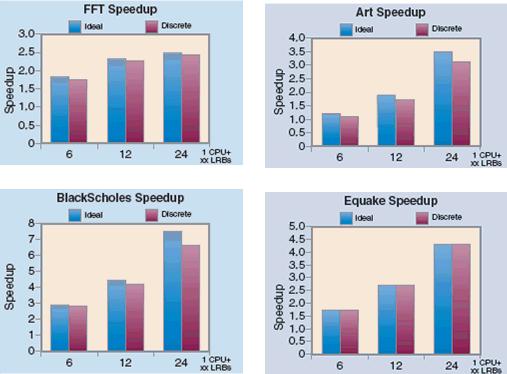
We used a number of well-known parallel non-graphics workloads [6] to measure the performance of our system. These include the Black Scholes financial workload that does option pricing by using the Black Scholes method; the fast fourier transform (FFT) workload that does a radix-2 FFT algorithm used in many domains, such as signal processing; the Equake workload, part of SpecOMP, that performs earthquake modeling, and that is representative of high-performance computer (HPC) applications; and Art, also part of SpecOMP, that performs image recognition. The reported numbers are based on using the standard input sets for each of the applications. All these workloads were rewritten by using our programming constructs and were compiled with our tool chain.

Figure 2: Percent of shared data in memory accesses.

Figure 2 shows the fraction that total memory accesses were to shared data in the aforementioned workloads. The vast majority of the accesses were to private data. Note that read-only data accessed by multiple threads were privatized manually. This manual privatization helped in certain benchmarks like Black Scholes. It is not surprising that most of the accesses are to private data, since the computation threads in the workloads privatize the data that they operate on to get better memory locality. We expect workloads that scale to a large number of cores to behave similarly, since the programmer must be conscious of data locality and avoid false sharing in order to get good performance. The partial virtual address sharing memory model lets us leverage this access pattern by cutting down on the amount of data that need to be kept coherent.

We next show the performance of our system on the set of workloads. We ran the workloads on a simulated system with 1 CPU core and varied the number of Larrabee cores from 6 to 24. The workload computation was split between the CPU and Larrabee cores, with the compute-intensive portions executed on Larrabee cores. For example, all the option pricing in Black Scholes and the earthquake simulation in Equake is offloaded to Larrabee cores. We present the performance improvement relative to a single CPU and Larrabee core. Figure 3 compares the performance of our system, when the application does not use any ownership calls, to the performance when the user optimizes the application further by using ownership calls. The bars labeled "Mine/Yours" represent the performance with ownership calls: (Mine implies pages were owned by CPU and Yours implies pages were owned by the Larrabee processor). The bars labeled "Ours" represent the performance without any ownership calls.

Figure 3: Ownership performance comparison.

As expected, the applications perform better with ownership calls than without. To understand the reason for this, we broke down the overhead of the system when the application was not using any ownership calls. Figure 4 shows the breakdown for Black Scholes. We show the breakdown for only one benchmark, but the ratios of the different overheads are very similar in all the benchmarks.

Figure 4: Overhead breakdown without ownership.

We break up the overhead into four categories.
* The first one relates to handling the page faults, since we use a virtual memory-based shared memory implementation, and reads/writes to a page after an acquire point triggers a fault.
* The second relates to the diff operation performed at release points to sync up the CPU and Larrabee copies of a page.
* The third is the amount of time spent in copying data from one side to the other. The copy operation is triggered from the page fault handler when either processor needs the latest copy of a page. We do not include the copy overhead as part of the page fault overhead, but present it separately, since we believe different optimizations can be applied to optimize it.
* Finally, the fourth one shows the overhead spent in synchronizing messages. Note that in a discrete setting, the Larrabee processor is connected to the CPU over the PCI-Express. The PCI-Express protocol does not include atomic read-modify-write operations. Therefore we have to perform some synchronization and hand shaking between the CPU and Larrabee processor by passing messages.

Figure 5: Overhead breakdown with ownership.

When the application uses ownership of arenas, the diff overhead is completely eliminated. The page fault handling is reduced, since the write page-fault handler does not have to create a backup copy of the page. Moreover, since we copy all the pages in one step when we acquire ownership of an arena, we do not incur read page faults.

Figure 6: Overall performance comparison.

This also significantly reduces the synchronization message overhead since the CPU and Larrabee processor perform the handshaking at only ownership acquisition points rather than at many intermediate points (e.g., whenever pages are transferred from one side to the other). Figure 5 shows the overhead breakdown with ownership calls.

Finally, Figure 6 shows the overall performance of our system. All the workloads used the ownership APIs. The "ideal" bar represents hardware-supported cache coherence between the CPU and Larrabee cores -- in other words, this is the best performance that our shared memory implementation can provide. For Equake, since the amount of data transferred is very small compared to the computation involved, we notice that "ideal" and "discrete" times are almost identical.

In all cases our shared memory implementation has low overhead and performs almost as well as the ideal case. Black Scholes shows the highest comparable overhead, since it has the lowest compute density: i.e., the amount of data transferred per unit computation time was the highest. Using Black Scholes we transfer about 13MB of data per second of computation time, while we transfer about 0.42MB of data per second of computation time when using Equake. Hence, the memory coherence overhead is negligible in Equake. The difference between the ideal scenario and our shared memory implementation increases with the number of cores, mainly due to synchronization overhead. In our implementation, synchronization penalties increase non-linearly with the number of cores.

Related Work

There exists other research that is closely related to the work explicated in this article. Most closely related are the CUDA [11], OpenCL [12] and CTM [2] programming environments. Just as our technology does, OpenCL uses a weakly consistent shared memory model, but it is restricted to the GPU. Our work differs from CUDA, OpenCL, and CTM in several ways: unlike these environments we define a model for communication between the CPU and Larrabee processor; we provide direct user-level communication between the CPU and Larrabee processor, and we consider a bigger set of C language features, such as function pointers. Implementing a similar memory model is challenging on current GPUs due to their inherent limitations.

The Cell processor [8] is another heterogeneous platform. While the power processor unit (PPU) is akin to a CPU, the synergistic processing units (SPUs) are much simpler than the Larrabee cores. For example, they do not run an operating system kernel. Unlike the SPU-PPU pair, the Larrabee processor and CPU pair is much more loosely coupled, since the Larrabee processor can be paired as a discrete GPU with any CPU running any operating system. Unlike our model, Cell programming involves explicit direct memory access (DMA) between the PPU and SPU. Our memory model is similar to that of PGAS languages [14, 17], and hence our language constructs are similar to those of Unified Parallel C (UPC) language [17]. However, UPC does not consider ISA or operating system heterogeneity. Higher-level PGAS languages such as X10 [14] do not support the ownership mechanism that is crucial for a scalable, coherent implementation in a discrete scenario. Our implementation has similarities to software-distributed shared memory [9, 4] which also leverages virtual memory. Many of these S-DSM systems also use release consistency and they copy pages lazily on demand. The main differences with S-DSM systems is the level of heterogeneity. Unlike S-DSM systems, our system needs to consider a computing system where the processors have different ISAs and system environments. In particular, we need to support different processors with different virtual-to-physical page mappings. Finally, the performance tradeoffs between S-DSMs and CPU with Larrabee processor systems are different: S-DSMs were meant to scale on large clusters, while CPU with Larrabee processor systems should remain small scale clusters for some time in the future. The CUBA [7] architecture proposes hardware support for faster communication between the CPU and GPU. However, the programming model assumes that the CPU and GPU are separate address spaces. The EXO [18] model provides shared memory between a CPU and accelerators, but it requires the page tables to be kept in sync, which isn't feasible in a discrete accelerator.

Conclusions

Heterogeneous computing platforms composed of a general-purpose scalar oriented CPU and throughput-oriented cores (e.g., a GPU) are increasingly being used in client computing systems. These platforms can be used for accelerating highly parallel workloads. There have been several programming model proposals for such platforms, but none of them address the CPU-GPU memory model. In this article we propose a new programming model for a heterogeneous Intel x86 system with the following key features:

* A shared memory model for all the cores in the platform.
* A uniform programming model for different configurations.
* User annotations to demarcate code for CPU and Larrabee execution.

We implemented the full software stack for our programming model including compiler and runtime support. We ported a number of parallel workloads to our programming model and evaluated the performance on a heterogeneous Intel x86 platform simulator. We show that our model can be implemented efficiently so that programmers are able to benefit from shared memory programming without paying a performance penalty.

References

[1] Adve S, Adve V, Hill M.D. and Vernon M.K. "Comparison of Hardware and Software Cache Coherence Schemes." International Symposium on Computer Architecture (ISCA), 1991.

[2] AMD CTM Guide. "Technical Reference Manual." 2006 Version 1.01. Available at http://www.amd.com

[3] AMD Stream SDK. Available at ati.amd.com/technology/streamcomputing.

[4] Amza C., Cox A.L., Dwarkadas S., Keleher P., Lu H., Rajamony R., Yu W., Zwaenepoel W. "TreadMarks: Shared Memory Computing on Networks of Workstations." IEEE Computer, 29(2): pages 18-28, February 1996.

[5] Boehm H., Adve S. "Foundations of the C++ memory model." Programming Language Design and Implementation (PLDI), 2008.

[6] Dubey P. "Recognition, Mining, and Synthesis moves computers to the era of tera." Available at Technology@Intel, February 2005.

[7] Gelado I., Kelm J.H., Ryoo S., Navarro N., Lumetta S.S., Hwu W.W. "CUBA: An Architecture for Efficient CPU/Co-processor Data Communication." ICS, June 2008.

[8] Gschwind M., Hofstee H.P., Flachs B., Hopkins M., Watanabe Y., Yamakazi T. "Synergistic Processing in Cell's Multicore Architecture." IEEE Micro, April 2006.

[9] Kontothanasis L., Stets R., Hunt G., Rencuzogullari U., Altekar G., Dwarkadas S., Scott M.L. "Shared Memory Computing on Clusters with Symmetric Multiprocessors and System Area Networks." ACM Transactions on Computer Systems, August 2005.

[10] Luebke, D., Harris, M., Krüger, J., Purcell, T., Govindaraju, N., Buck, I., Woolley, C., and Lefohn, A. "GPGPU: general purpose computation on graphics hardware." SIGGRAPH, 2004.

[11] Nvidia Corporation. "CUDA Programming Environment." Available at www.nvidia.com/

[12] OpenCL 1.0. Available at http://www.khronos.org/opencl/

[13] Ryoo S., Rodrigues C.I., Baghsorki S.S., Stone S.S., Kirk D.B., Hwu W.W. "Optimization Principles and Application Performance Evaluation of a Multithreaded Larrabee using CUDA." Principles and Practice of Parallel Programming (PPoPP), 2008.

[14] Saraswat, V. A., Sarkar, V., and von Praun, C. "X10: concurrent programming for modern architectures." PpoPP, 2007.

[15] Saha, B., Adl-Tabatabai, A., Ghuloum, A., Rajagopalan, M., Hudson, R. L., Petersen, L., Menon, V., Murphy, B., Shpeisman, T., Sprangle, E., Rohillah, A., Carmean, D., and Fang, J. "Enabling scalability and performance in a large scale CMP environment." Eurosys, 2007.

[16] Seiler L., Carmean D., Sprangle E., Forsyth T., Abrash M., Dubey P., Junkins S., Lake A., Sugerman J., Cavin R., Espasa R., Grochowski E., Juan T., Hanrahan P. "Larrabee: A Many-Core x86 Architecture for Visual Computing." ACM Transactions on Graphics, August 2008.

[17] "UPC Consortium, UPC language specifications." Lawrence Berkeley National Lab Tech Report LBNL-59208, 2005.

[18] Wang P., Collins J.D., Chinya G. N., Jiang H., Tian X., Girkar M., Yang N. Y., Lueh G., Wang H. "Exochi: Architecture and programming environment for a heterogeneous multi-core multithreaded system." Programming Language Design and Implementation (PLDI), 2007.

Acknowledgments

We thank the following people who provided us with much support in this work: Jesse Fang, Ian Lewis, Antony Arciuolo, Kevin Myers, Robert Geva, Ravi Narayanaswamy, Milind Girkar, Rajiv Deodhar, Stephen Junkins, David Putzolu, Allen Hux, Peinan Zhang, Patrick Xi, Dean Macri, Nikhil Rao, Rob Kyanko, Madan Venugopal, Srinivas Chennupaty, Stephen Van Doren, Allen Baum, Martin Dixon, Ronny Ronen, Stephen Hunt, Larry Seiler, and Mike Upton.

This article and more on similar subjects may be found in the Intel Technology Journal, December 2009 Edition, "Addressing the Challenges of Tera-scale Computing". More information can be found at http://intel.com/technology/itj. Sphere: Related Content

20/7/10

The Four Polymorphisms in C++

When people talk about polymorphism in C++ they usually mean the thing of using a derived class through the base class pointer or reference, which is called subtype polymorphism. But they often forget that there are all kinds of other polymorphisms in C++, such as parametric polymorphism, ad-hoc polymorphism and coercion polymorphism.

These polymorphisms also go by different names in C++,
- Subtype polymorphism is also known as runtime polymorphism.
- Parametric polymorphism is also known as compile-time polymorphism.
- Ad-hoc polymorphism is also known as overloading.
- Coercion is also known as (implicit or explicit) casting.
In this article I'll illustrate all the polymorphisms through examples in C++ language and also give insight on why they have various other names.

Subtype Polymorphism (Runtime Polymorphism)
Subtype polymorphism is what everyone understands when they say "polymorphism" in C++. It's the ability to use derived classes through base class pointers and references.

Here is an example. Suppose you have various cats like these felines,

Since they are all of Felidae biological family, and they all should be able to meow, they can be represented as classes inheriting from Felid base class and overriding the meow pure virtual function,
// file cats.h

class Felid {
public:
virtual void meow() = 0;
};

class Cat : public Felid {
public:
void meow() { std::cout << "Meowing like a regular cat! meow!\n"; }
};

class Tiger : public Felid {
public:
void meow() { std::cout << "Meowing like a tiger! MREOWWW!\n"; }
};

class Ocelot : public Felid {
public:
void meow() { std::cout << "Meowing like an ocelot! mews!\n"; }
};

Now the main program can use Cat, Tiger and Ocelot interchangeably through Felid (base class) pointer,
#include
#include "cats.h"

void do_meowing(Felid *cat) {
cat->meow();
}

int main() {
Cat cat;
Tiger tiger;
Ocelot ocelot;

do_meowing(&cat);
do_meowing(&tiger);
do_meowing(&ocelot);
}
Here the main program passes pointers to cat, tiger and ocelot to do_meowing function that expects a pointer to Felid. Since they are all Felids, the program calls the right meow function for each felid and the output is:
Meowing like a regular cat! meow!
Meowing like a tiger! MREOWWW!
Meowing like an ocelot! mews!
Subtype polymorphism is also called runtime polymorphism for a good reason. The resolution of polymorphic function calls happens at runtime through an indirection via the virtual table. Another way of explaining this is that compiler does not locate the address of the function to be called at compile-time, instead when the program is run, the function is called by dereferencing the right pointer in the virtual table.

In type theory it's also known as inclusion polymorphism.

Parametric Polymorphism (Compile-Time Polymorphism)
Parametric polymorphism provides a means to execute the same code for any type. In C++ parametric polymorphism is implemented via templates.

One of the simplest examples is a generic max function that finds maximum of two of its arguments,
#include
#include

template
T max(T a, T b) {
return a > b ? a : b;
}

int main() {
std::cout << ::max(9, 5) << std::endl; // 9

std::string foo("foo"), bar("bar");
std::cout << ::max(foo, bar) << std::endl; // "foo"
}
Here the max function is polymorphic on type T. Note, however, that it doesn't work on pointer types because comparing pointers compares the memory locations and not the contents. To get it working for pointers you'd have to specialize the template for pointer types and that would no longer be parametric polymorphism but would be ad-hoc polymorphism.

Since parametric polymorphism happens at compile time, it's also called compile-time polymorphism.

Ad-hoc Polymorphism (Overloading)
Ad-hoc polymorphism allows functions with the same name act differently for each type. For example, given two ints and the + operator, it adds them together. Given two std::strings it concatenates them together. This is called overloading.

Here is a concrete example that implements function add for ints and strings,
#include
#include

int add(int a, int b) {
return a + b;
}

std::string add(const char *a, const char *b) {
std::string result(a);
result += b;
return result;
}

int main() {
std::cout << add(5, 9) << std::endl;
std::cout << add("hello ", "world") << std::endl;
}
Ad-hoc polymorphism also appears in C++ if you specialize templates.Returning to the previous example about max function, here is how you'd write a max for two char *,
template <>
const char *max(const char *a, const char *b) {
return strcmp(a, b) > 0 ? a : b;
}
Now you can call ::max("foo", "bar") to find maximum of strings "foo" and "bar".

Coercion Polymorphism (Casting)
Coercion happens when an object or a primitive is cast into another object type or primitive type. For example,
float b = 6; // int gets promoted (cast) to float implicitly
int a = 9.99 // float gets demoted to int implicitly
Explicit casting happens when you use C's type-casting expressions, such as (unsigned int *) or (int) or C++'s static_cast, const_cast, reinterpret_cast, or dynamic_cast.

Coercion also happens if the constructor of a class isn't explicit, for example,
#include

class A {
int foo;
public:
A(int ffoo) : foo(ffoo) {}
void giggidy() { std::cout << foo << std::endl; }
};

void moo(A a) {
a.giggidy();
}

int main() {
moo(55); // prints 55
}
If you made the constructor of A explicit, that would no longer be possible. It's always a good idea to make your constructors explicit to avoid accidental conversions.

Also if a class defines conversion operator for type T, then it can be used anywhere where type T is expected.

For example,
class CrazyInt {
int v;
public:
CrazyInt(int i) : v(i) {}
operator int() const { return v; } // conversion from CrazyInt to int
};
The CrazyInt defines a conversion operator to type int. Now if we had a function, let's say, print_int that took int as an argument, we could also pass it an object of type CrazyInt,
#include

void print_int(int a) {
std::cout << a << std::endl;
}

int main() {
CrazyInt b = 55;
print_int(999); // prints 999
print_int(b); // prints 55
}
Subtype polymorphism that I discussed earlier is actually also coercion polymorphism because the derived class gets converted into base class type. Sphere: Related Content